Dad’s Hat Rye with Herman Mihalich Show Notes
Dad’s Hat Rye: Bringing Pennsylvania Back, One Mashbill at a Time
Sometimes a distillery starts with a business plan. Sometimes it starts with a bar. For Dad’s Hat Rye, it’s a bit of both, layered across generations. When I sat down with Herman Mihalich, the story didn’t begin in a warehouse or a lab, but above a family bar in western Pennsylvania, where rye whiskey wasn’t a category so much as a constant presence.
Herman grew up in Monessen along the Monongahela River, where his grandfather’s bar served local rye to steelworkers coming off shift. Brands like Sam Thompson and Gibson weren’t rare or romanticized, they were simply what you drank. Over time, though, those bottles disappeared. By the 1980s, rye had faded to the point where Old Overholt was one of the only options left on the shelf. The category didn’t just decline, it nearly vanished.
That’s part of what made a 2006 New York Times article so impactful. It framed rye as a category on the verge of revival, driven by bartenders and enthusiasts rediscovering classic cocktails. For Herman, it turned a casual idea into something worth pursuing. What had been a half-joking conversation about bringing whiskey back to Pennsylvania began to feel possible. His wife tracked down many of the bottles mentioned in that article, including some that would be considered nearly impossible to find today. He drank through them, forming a sense of what rye had been and what it might become again. Some stood out, others didn’t, but the bigger takeaway was that the category still had life in it.
At the time, Pennsylvania didn’t. Michter’s had left the state in 1989, and for two decades no one was producing whiskey there. By 2011, that gap finally closed.
Before they ever filled a barrel, Herman and his co-founder spent about a year focused on research. Not just modern distilling practices, but the specifics of historical Pennsylvania rye. What defined it, what made it distinct, and how much of that could realistically be brought forward. That process took them to Michigan State University, where they worked with microbiologists and distilling experts to develop a mashbill rooted in tradition but informed by modern understanding.
The result became the foundation for Dad’s Hat: 80% rye and 20% malt, with no corn. That malt component is split between roughly 15% malted barley and 5% malted rye, providing both enzymatic support and an added layer of grain complexity. It’s a profile that immediately sets it apart from many contemporary ryes, especially those coming out of Kentucky where corn often softens the edges and creates a bridge from bourbon. Dad’s Hat doesn’t try to build that bridge. It leans into a more assertive, grain-forward identity.
There’s often a tendency to tie Pennsylvania rye directly to the Monongahela region, and while Herman grew up there, the distillery itself is located in eastern Pennsylvania. Even so, the whiskey follows what he sees as the defining characteristics of that traditional style: high rye content, a meaningful percentage of malt for enzymatic conversion, sweet mash fermentation, and controlled aging. In that sense, the style isn’t strictly about geography. It’s about approach.
Starting a distillery in Pennsylvania in 2011 meant building something without much of a local framework to lean on. There wasn’t an established craft distilling ecosystem, and there were very few recent examples to follow. The space they chose, a converted mill in the Philadelphia suburbs, became part of the identity. Industrial but personal, shaped as much by family history as by function. Even the name Dad’s Hat, inspired by Herman’s father’s fedoras, came together naturally rather than through a drawn-out branding exercise.
From a production standpoint, there’s a clear emphasis on control and consistency, especially during fermentation. Rye is known for being difficult to work with, particularly because of its tendency to foam and gum up during processing. Longer, temperature-controlled fermentations help manage that, along with a careful balance of enzymes to ensure proper conversion without overcomplicating the process. It’s a system that reflects both practical experience and a more analytical approach, supported by having engineering expertise on the team.
The still setup adds another layer of flexibility. A pot still with a side column allows them to adjust how they run each batch, depending on what they’re trying to achieve. It’s not about locking into a single method, but about having options.
On the maturation side, the early years looked a lot like many other craft distilleries. Smaller barrels, including 15-gallon casks, helped bring whiskey to market more quickly. The original Classic Rye was designed with cocktails in mind, aged just long enough to develop character without letting oak take over. As production grew, they moved into larger barrels, including full-size 53-gallon casks, which opened the door to longer aging and more complex expressions.
One interesting aspect of their process is how they handle storage and batching. Because they use shared tanks, even a small amount of younger whiskey can technically define the age statement of what’s in that tank. It’s less about manipulating perception and more about working within the realities of a small distillery, where efficiency and practicality often shape decisions.
Grain sourcing has always stayed close to home. From the beginning, they’ve worked with Pennsylvania farms, reinforcing the connection between the whiskey and the place it comes from. That relationship has extended into projects like reviving Rosen Rye, a once-prominent grain variety that had largely disappeared. Bringing it back into production mirrors the broader theme of the distillery itself, rediscovering something that had been lost and finding a way to make it relevant again.
Farming, of course, comes with its own uncertainties. Weather, timing, and yield all play a role, and not every year looks the same. But that variability is part of what makes the end product feel grounded in something real.
When it comes to legacy, Herman doesn’t spend much time dwelling on it. There’s an awareness of Dad’s Hat’s role in bringing Pennsylvania rye back into the conversation, but the focus stays on the present. Making the whiskey, refining the process, and continuing to introduce people to a style that still feels new to many drinkers.
Rye is no longer a forgotten category, but it’s still finding its footing with a broader audience. The renewed attention from larger producers has helped raise awareness, even if the benefits are still playing out. For smaller distilleries, it remains a slow build.
What’s clear, though, is that Pennsylvania rye isn’t just a historical footnote anymore. It’s part of an active conversation again, shaped by distillers who are as interested in where it came from as they are in where it’s going.
Dad’s Hat Rye/Mountain Laurel Spirits
Website: https://dadshatrye.com/
Instagram: https://www.instagram.com/dadshatrye/
Facebook: https://www.facebook.com/dadshatrye/
LinkedIn: https://www.linkedin.com/company/mountain-laurel-spirits/
If you haven’t joined the Patreon community yet, please consider doing so at patreon.com/whiskeyinmyweddingring
As of December 2025, the $25/month bottle share club level is sold out!
Join at the $5/month level for first shot at an open spot when a member retires and to keep receiving ad-free episodes via Patreon.
If you haven’t yet, please follow Whiskey in my Wedding Ring and the Whiskey Ring Podcast on Instagram and Facebook.
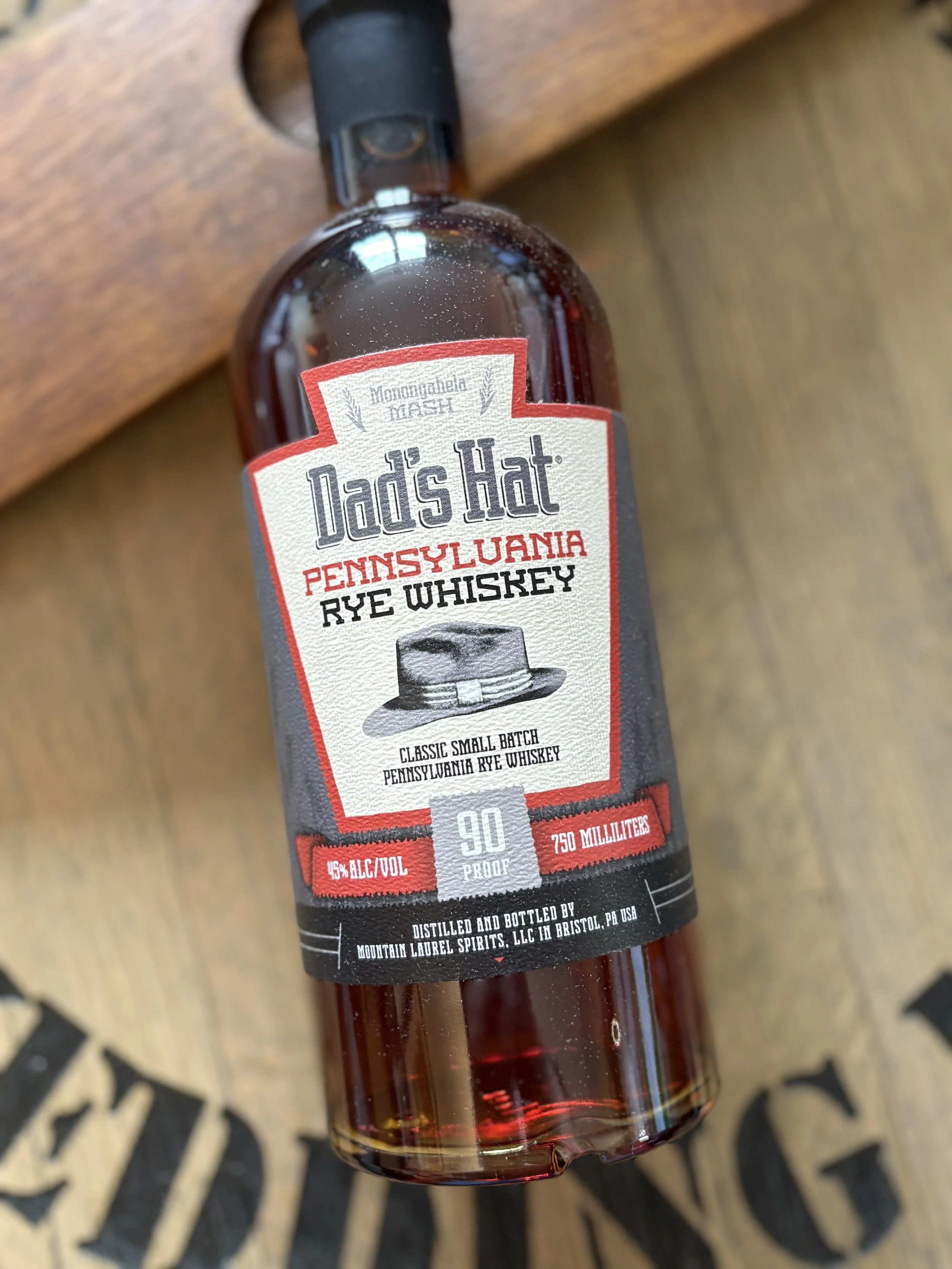
Dad’s Hat Pennsylvania Rye Whiskey: Specs
Classification: Pennsylvania Rye Whiskey
Producer: Dad’s Hat (Mountain Laurel Spirits)
Mash Bill: 80% Rye, 15% Malted Barley, 5% Malted Rye
Proof: 90º (45% ABV)
Age: 8 Months to 1 Year
Location: Pennsylvania
Dad’s Hat Pennsylvania Rye Whiskey Price: $39.99
Dad’s Hat Pennsylvania Rye Whiskey: Tasting Notes
Eye: Light maple syrup. Thin rims, no legs, splotchy drops.
Nose: Bright, grassy and lemony, like more than 5% of the rye is malted. Some youthful grain notes, but none that are turn-offs, and no wood. Haybales, toasted grain bread. Mild proof and a light barnyard funk.
Palate: Sweet, mildly piquant, more oak tannins popping up but not overly much. The malt gives a brewery vibe, enough to be the scent of a brewery without being yeasty. Lemon, fresh in a cocktail. Mouthfeel is lightly astringent, coats the tongue, medium-bodied, grassy malt and spring rye that turns minty. Brown sugar caramels. Raspberry lemon iced tea.
Finish: Jalapeno spice on the back palate, sits on the front half of my tongue with a more classic rye spice and dark sugars. Short side of medium, coating dries quickly.
Overall: Exactly what it purports to be, and the intention is fulfilled. Has youth, but not because of the wood, and the grain is matured and esterified enough to not taste yeasty. Clearly the tighter cuts worked. Pour remains bright and lemony, like a young Scottish malt rather than a young rye. The spice comes later for the rye, along with a drying finish and a flash of heat. Solid and far better than 90% of the 1-year-old ryes (or any spirits) I’ve had.
Rating: 7.2
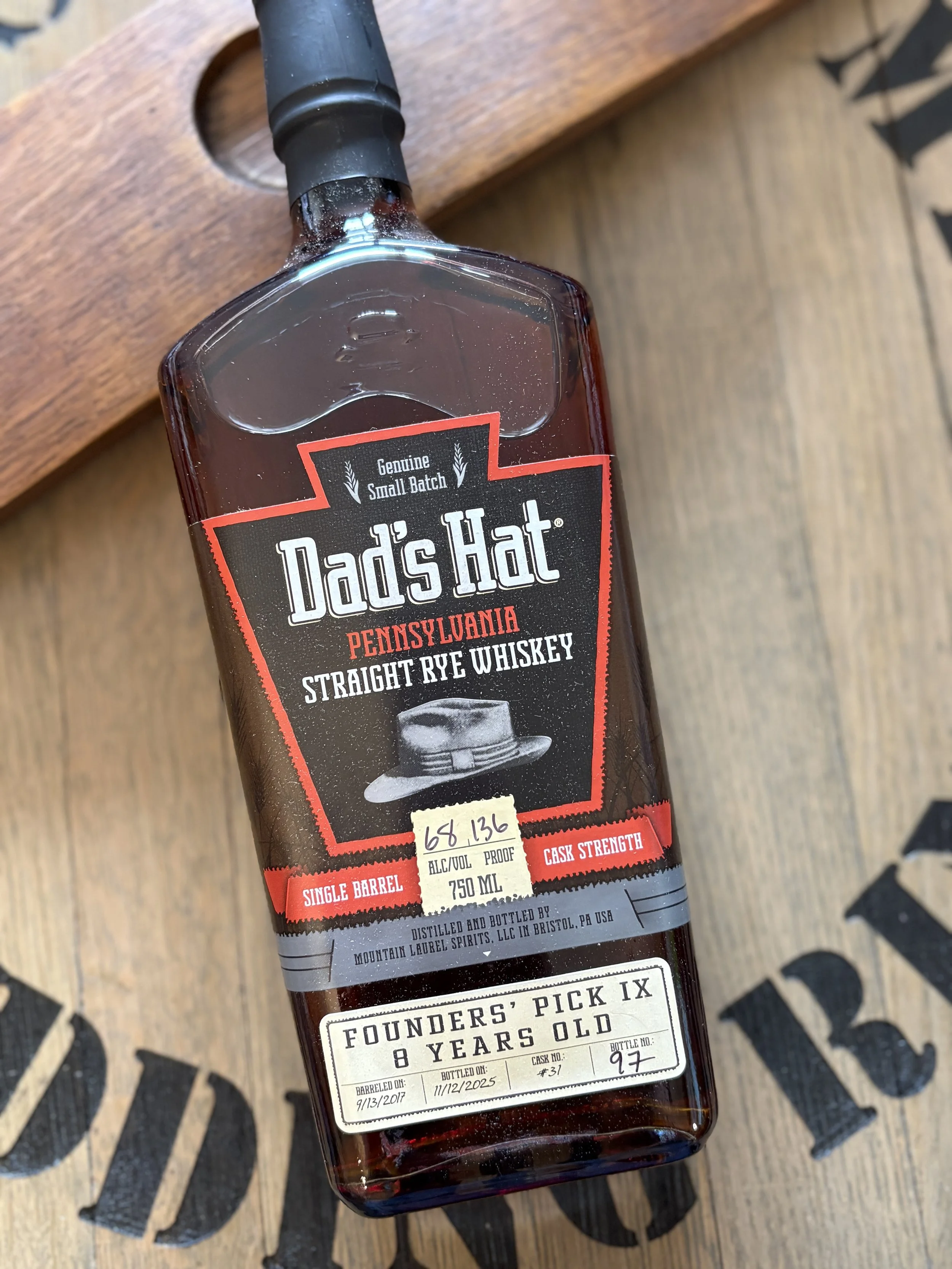
Dad’s Hat Pennsylvania Straight Rye Whiskey Founder’s Pick IX: Specs
Classification: Pennsylvania Rye Whiskey
Producer: Dad’s Hat (Mountain Laurel Spirits)
Mash Bill: 80% Rye, 15% Malted Barley, 5% Malted Rye
Proof: 136º (68% ABV)
Age: 8 Years Old
Location: Pennsylvania
Dad’s Hat Pennsylvania Straight Rye Whiskey Founder’s Pick IX Price: $88.88
Dad’s Hat Pennsylvania Straight Rye Whiskey Founder’s Pick IX: Tasting Notes
Eye: Amber maple syrup. Thin rims, variegated legs, and stray droplets.
Nose: Deep caramelization in a copper pot, candy being made. Surprisingly mild proof, no oak. Manuka honey, a touch of smoke. Lemon balm and - I know this is super specific - hyssop. Cooled wood after it’s been toasted.
Palate: Blast of flavor front and center down to the mid-palate, dark honey and a nutty, turtle-esque chocolate and caramel blend. Proof still relatively undetected, no need to adjust to the higher proof. Herbal, amaro notes, and I kind of like the sweet-bitter balance, like a great cocktail. Mouthfeel brings intense herbal liquors, not coating or astringent, lighter than expected body, tannic black tea.
Finish: More coating upper palate, maple and smoke open up alongside more sweetness and a little pullback on the herbs, more like a Ricola without the mint component. Medium-to-long.
Overall: Herbal, but much more balanced than I would have expected for conjuring up the amaro notes. Sweet-herb goes back and forth. I know I’ll get called out for the specificity of the hyssop, but that’s exactly what I tasted, plus mildly smoky manuka honey. I quite enjoy this, the finish is full and long, lingering sweetness and a candied citrus peel finish.
Rating: 7.3
More Show Notes