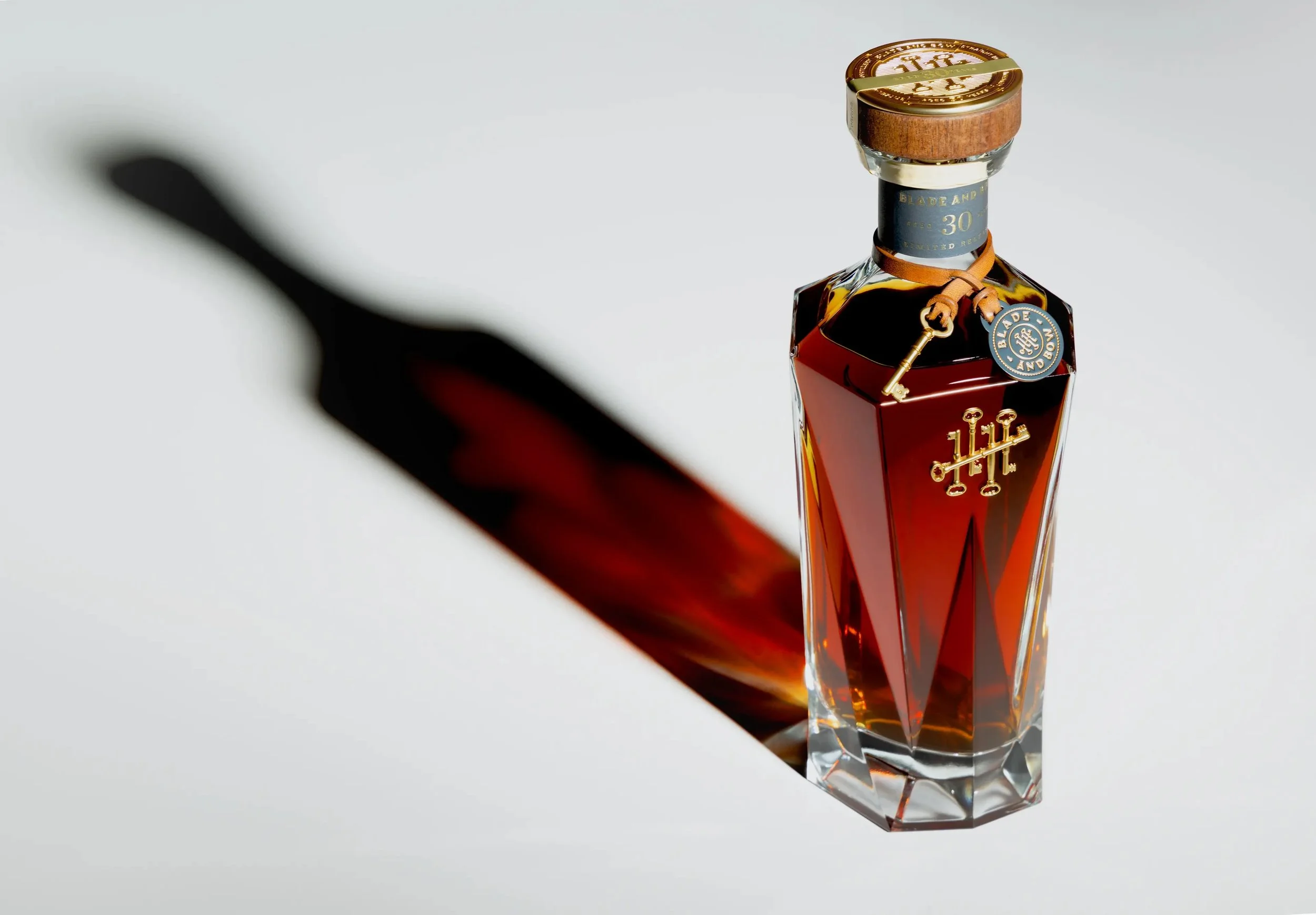
Blade and Bow 30-Year-Old Kentucky Straight Bourbon Whiskey
Photo credit: Diageo, Stitzel-Weller Distillery.
This is an unmitigated triumph.
The Blade and Bow 30 Year Old Kentucky Straight Bourbon is a top-five-in-my-life kind of bourbon, alongside William Heavenhill 4th Edition (Green Label), George T. Stagg 2002, Michter’s 25 Year Old, and Elijah Craig Barrel Proof Pre-Batch Gift Shop release.
This release should also convince any remaining holdouts - if there are any - that Nicole Austin is a singular talent in this industry. Her ability to take barrels from the pre-Diageo days, once (maybe twice) consolidated, and produce a three-decade-old bourbon that doesn’t have more than a hint of oak is masterful. I could write an entire piece just about the skill involved here, and I hope to have the chance to talk to her about it.
Even the greatest skill requires great product to succeed, though, so what about the barrels?
The story of these barrels is fascinating. I’ll leave it to my friend Jacob Kiper, aka ComingWhiskey, to tell the full story here, and I’ll include the CliffNotes. Distilled on March 4, 1993, the final barrels were dumped August 23, 2023, for a total age of 30 years, 5 months, and 19 days. At about the halfway mark, the original barrels were consolidated into between 90-100 barrels. Since they were consolidated, the age statement continued to rise rather than be cut off at that point. For the second half of maturation - somewhere between 10-15 years, at least - they aged on the top floor of the Stitzel-Weller warehouse in Louisville.
The warehouse’s unique conditions - again, please read Jacob’s writeup on this - led to different evaporative rates than a typical hyper-aged bourbon would experience. By consolidating the barrels, Diageo had already curbed both oxidation and evaporation by re-raising the fill level of the resultant casks. The location in the warehouse - top floor - meant more water evaporation than alcohol. This is particularly important for tannins: less water means less tannin extraction. At a decade-plus of age already, it’s likely there weren’t a whole lot of tannins left in those barrels, but any reason for them not to be there is a positive in my book.
At time of dumping, the whiskey was at an ungodly high proof, flocculating at 120º, which I haven’t heard of before (normal flocculation, where the oils/fats in the spirit come out of suspension, happens around 92º or below, hence why many companies chill filter below that proof). That is an intense concentration of oils.
With around 90-100 casks remaining, most at ⅓ full or more, Nicole considered doing a cask strength version - one might or might not still happen - but instead went with a more approachable release proof of 109 (54.5% ABV). Much as I’d love to see what a bourbon at over 160º tastes like (closest I’ve come is Jack Daniel’s Coy Hill Batch 2 or a light whiskey), it’s hard to argue against the near-perfection of this product. My only hesitation against calling it perfect is a brief ethanol flash at the start of the palate and the thought that this could have an even better body given a few more proof points (and thus a little more of those oils).
An outstanding question still remains: where was this distilled? Most legendary whiskies, or ones that become legendary, have an origin story. We know where the original Pappys and Staggs were distilled, the A. H. Hirsch from Schaefferstown, etc. Surprisingly, this one does not. According to Austin, the batch codes and date of distillation are on these barrels, but not the distillery or mashbill. We do know, however, that it is a ryed bourbon mashbill, no wheat. With United Distillers building Bernheim in 1992, that’s certainly a top guess, but for now we simply don’t know.
For once, I kind of like not knowing. Knowing invites - no, requires - comparison. Without knowing what peers this whiskey might have, it is allowed to stand on its own, a testament both to its original makers and to the genius of its eventual release.
I’ll end with this. The MSRP is $1,200, high to begin with and unlikely to be found in the wild at said price. I don’t think this price is unwarranted. It puts it on par with Michter’s 20 Year Old, which would be in my top five bourbons above if I hadn’t also had the 25-year-old. Only a few proof points separate these two, though at least a decade of aging can shine quite brightly between them. Both have the inestimable quality of being hyper aged and not tannic, intensely flavorful, and, in my opinion, worthy of their prices.
Which would I choose? I honestly don’t know. I only know that if I did see this at MSRP and had $1,200 to burn, it would be an instant buy that I would share judiciously, an experiential pour for as long as I could make the bottle last.
Blade and Bow 30-Year-Old Kentucky Straight Bourbon Whiskey: Specs
Classification: Kentucky Straight Bourbon Whisky
Producer: Diageo, via Stitzel-Weller Distillery
Mash Bill: Unknown, Ryed Bourbon
Proof: 109º (54.5% ABV)
Age: 30 Years Old
Location: Kentucky
Blade and Bow 30-Year-Old Kentucky Straight Bourbon Whiskey Price: $1,200
Blade and Bow 30-Year-Old Kentucky Straight Bourbon Whiskey: Tasting Notes
Eye: Dark maple. Barely-there rims, thin legs, tiny droplets.
Nose: Fruity, fried and fresh strawberries, incredible bouquet of caramels and red stone fruits. Hints of varnish, warm wood, pecan pie filling, blondie mix, high quality vanilla, dried strawberry reasserting every few seconds.
Palate: Arbikie Wild Strawberry Vodka hits up front, that fresh, whole-fruit vodka that’s so rare. Some ethanol on the tip of my tongue followed by fruit leather and fresh varnish. Stays mostly front tongue, opens to cherry and watermelon candies. I am stunned by how little oak I’m getting in flavor or astringency. Mouthfeel is gently gripping on the front tongue and along the sides, white chocolate-dipped fruits emerging. Mild numbing over the whole palate, old dusty caramels you get from dusty bourbons, stave astringency lurking behind some root beer.
Finish: True dusty notes of varnish and old leather, but the strawberry-led fruitiness keeps it bright. Grips the back palate and holds on, orange creamsicle opening late. Medium to long finish, medium bodied.
Overall: I need to contemplate this. The only other bourbons/American whiskies I’ve had at this age that weren’t oaked to hell were the Michter’s 20, 25, and Celebration Sour Mash. How in the name of sanity does this not have so much more oak? The strawberry fruit leather and occasional fresh wild strawberry brightens this up beautifully, with red stone fruits adding tart, sweet, and a little bitterness, engaging all the way through. The texture remains steady, medium-to-full-bodied from nose to finish. The pecan pie filling, that slightly gooey, slightly dry texture of sugary goodness, is always around the edges. I’d buy this as a candle since I likely can’t afford the bottle.
Final Rating: 9.5
10 | Insurpassable | Nothing Else Comes Close
9 | Incredible | Extraordinary
8 | Excellent | Exceptional
7 | Great | Well above average
6 | Very Good | Better than average
5 | Good | Good, solid, ordinary
4 | Has promise but needs work
1-3 | Let’s have a conversation
More Stitzel-Weller Reviews