Lost Lantern United States of Bourbon: Nora Ganley-Roper on Blending Bourbon From All 50 States
Lost Lantern is back on The Whiskey Ring Podcast, and at this point, I think Nora Ganley-Roper and Adam Polonski may have quietly turned into the show’s house band.
If you’ve followed my writing over the last few years, you know Lost Lantern has become one of the American whiskey companies I return to most often, both as a drinker and as someone trying to understand where American craft whiskey is actually going. They’re not simply buying barrels and putting labels on them. At their best, they’re doing the harder thing: building context. They find distilleries most drinkers have never heard of, put them next to names with national reputations, and make the case that American whiskey isn’t a single road running through Kentucky. It’s a whole highway system, some paved, some gravel, some still being cleared by hand.
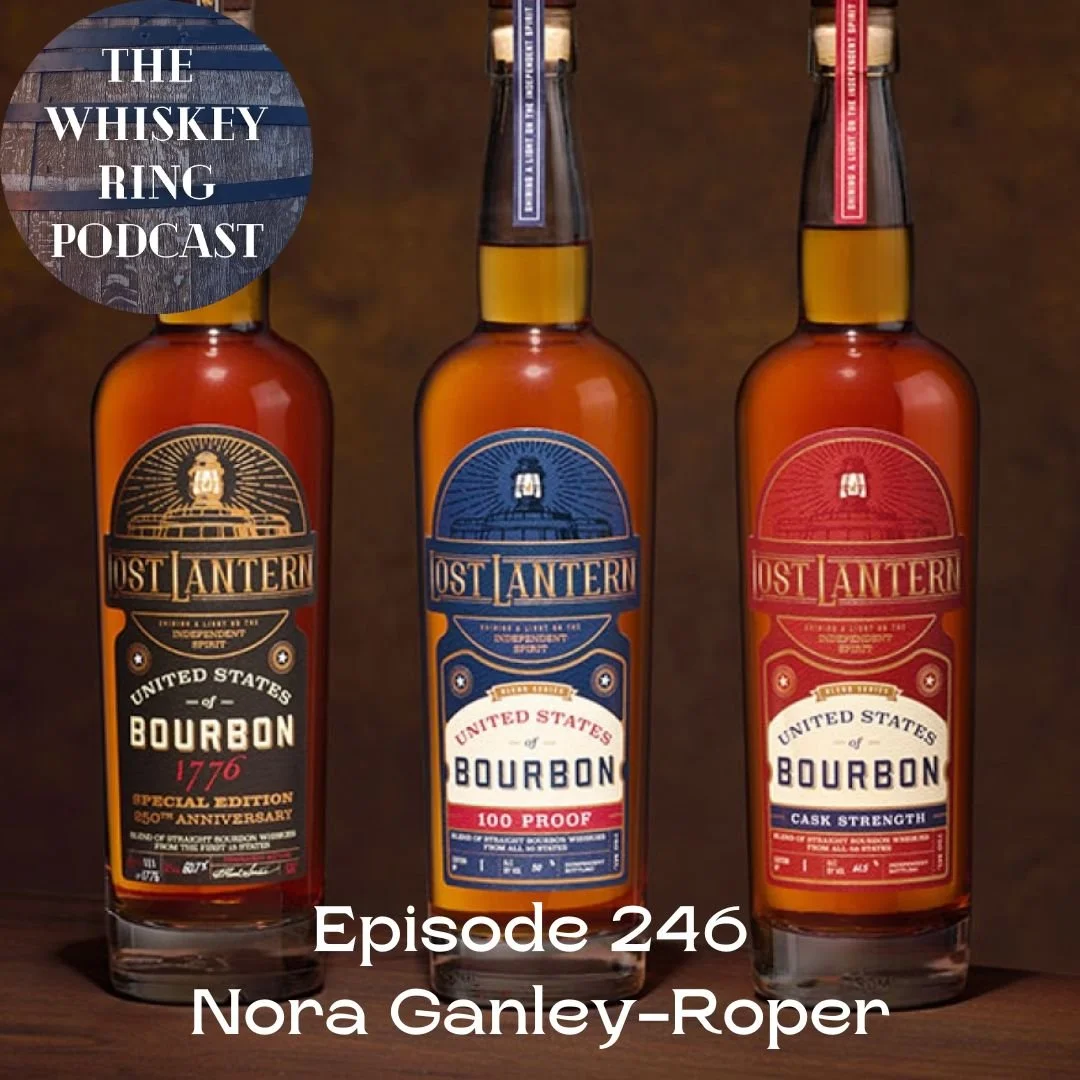
Nora, co-founder of Lost Lantern, joins me to talk about United States of Bourbon, one of the most ambitious projects I’ve seen in American whiskey. The idea is simple enough to explain and almost absurdly difficult to execute: a straight bourbon blend made with bourbon from all 50 states, each state represented by one distillery, all brought together into a whiskey that needed to be much more than a map trick.
There are three releases tied to the project: United States of Bourbon 100 Proof, United States of Bourbon Cask Strength, and the 1776 Edition, a one-time blend of straight bourbons from the original 13 states released for the 250th anniversary of the United States. I reviewed the Cask Strength version shortly before this conversation and gave it a 9.2, a Platinum Medal, and one of the highest ratings I’ve given this year. The only reason it came in just under Far-Flung Bourbon IV is that Far-Flung IV was, by its nature, a more focused blend. United States of Bourbon had to do something different. It had to include all 50 states, hold together 50 components, and still drink as bourbon.
That’s a much narrower target than it sounds.
A Lost Lantern Idea That Started Before Lost Lantern
One of the most fascinating parts of this episode is that United States of Bourbon isn’t a sudden bicentennial-adjacent brainstorm. Nora and Adam had been talking about something like this before Lost Lantern officially launched.
That tracks with how Lost Lantern has always seemed to think. Their blends are usually wide-angle views of American whiskey: Far-Flung Bourbon, Far-Flung Rye, Shadow for peated American single malt, the Farmers’ Fields releases for grain-forward state stories. The throughline isn’t just “here are some barrels we liked.” It’s “here’s a piece of the industry you can’t see clearly from one distillery alone.”
A bourbon from all 50 states was the most expansive version of that idea, but in 2018 it may not have been possible. There were whiskey brands in every state, certainly. There were probably bourbon labels in every state. But bourbon actually distilled in every state, old enough to qualify as straight bourbon, good enough to use, available to purchase, and made by a distillery willing to work with an independent bottler? That’s a different beast entirely, and it’s one with paperwork, truck routes, barrel samples, aging statements, and a habit of laughing at your calendar.
For years, the idea sat in the realm of “wouldn’t that be incredible?” Then American craft whiskey matured around it. More distilleries came online. More barrels reached age. Lost Lantern’s own reputation grew. Distilleries that might once have been skeptical of independent bottling had proof that Nora and Adam would treat their whiskey, their name, and their story with care.
That last piece is key, because Lost Lantern’s work depends on trust. The distillery has to trust that Lost Lantern will present the whiskey fairly. The drinker has to trust that the bottle is more than novelty. And Nora, as blender, has to trust that the components will eventually stop behaving like fifty separate conversations and start sounding like one whiskey.
From Red to Green: Tracking Bourbon Across the Country
As the project became more plausible, Adam tracked the country on a map. Some states were red, meaning no obvious bourbon or no obvious partner. Then they moved to orange, yellow, and eventually green as distilleries emerged, whiskey came of age, or relationships developed enough to make the project realistic.
The real decision point came in 2024, when Adam told Nora he thought they might finally be able to do it. Not that they definitely could, only that bourbon existed in the right places and the right conversations were worth having.
So they started with the states that could kill the whole thing.
That meant places like North Dakota, Idaho, Hawaii, New Mexico, and other states where there might only be one or two realistic options. Those are the states where a single no, a single too-young barrel, or a single whiskey that didn’t meet the bar could stop the entire project cold. It would’ve made no sense to spend time buying bourbon from Iowa, Texas, New York, Kentucky, or Tennessee if Idaho or North Dakota could sink the ship before it left the harbor.
I love that because it reveals how unglamorous a project like this really is underneath the final story. The headline is “bourbon from all 50 states.” The work is figuring out whether a barrel from Nantucket needs to come by boat, whether Hawaii can ship in a way that makes sense, whether Alaska can move over land, whether Oklahoma can spare only one barrel, and whether the one barrel you need from a state with very few options actually arrives safely.
Nora said they were nervous until every barrel was physically in their Vermont warehouse. I don’t blame her!
Why the Whiskey Had to Be Straight Bourbon
Lost Lantern made one key decision early: every component had to be straight bourbon.
That meant at least two years old, no additives, no shortcuts, and no “well, technically this helps the label story” compromises. Nora was clear that the whiskey also had to taste like bourbon. Not necessarily Kentucky bourbon, and not necessarily the most familiar cherry-vanilla-caramel profile in the world, but if tasted blind, it had to land clearly inside bourbon.
That restraint is part of why the final whiskey works.
It would’ve been easy for United States of Bourbon to become a nerdy oddity. Equal parts from every state would’ve been extremely clean from a marketing perspective and probably much messier in the glass. Leaning into the strangest components would’ve made the blend a fun academic exercise, but Lost Lantern was aiming for something broader. Nora wanted a bourbon that could speak to serious whiskey people without only speaking to serious whiskey people.
That’s a balance Lost Lantern has gotten better and better at striking. Their best work respects the enthusiast without trapping the whiskey in enthusiast-only territory. United States of Bourbon is full of lesser-known grains, unusual climates, small distilleries, closed distilleries, and regional quirks, but the whiskey doesn’t drink like a pile of footnotes. It drinks like bourbon.
That was the hard part.
The Blend: Foundation, Accents, and Seasoning
Nora’s blending process for United States of Bourbon had three broad stages, and the structure makes a lot of sense once you taste the whiskey.
First came the foundation, roughly two-thirds of the blend, built from about a dozen distilleries. That base had to establish the bourbon identity and be strong enough to stand on its own. It didn’t have to provide every detail, every texture, or every high note, but it had to give the blend its center of gravity.
Then came the accent components, the barrels that brought complexity, structure, mid-palate, density, fruit, spice, lift, or balance.
Finally came the seasoning. These are the whiskies that can swing a blend quickly: very high-proof bourbon, extremely oaky bourbon, unusually dense bourbon, or a component with one note that flashes through the room the second it hits the glass. Rich Grain from Mississippi is a good example. I’ve had a few Lost Lantern Rich Grain releases now, and that whiskey doesn’t exactly tiptoe into the room. Nora described it as salt and pepper in this blend, which feels right.
That’s the kind of detail that separates a good concept from a good blend. Fifty components could easily become clutter. Nora had to decide which barrels could carry weight, which could add shape, which could add color, and which needed to be used with tweezers.
The final whiskey succeeds because it has breadth without blur. It feels national without tasting generic.
American Bourbon Regionality, Used Carefully
One of the ideas that came up in the research around this release was regionality. Adam has talked about broad regional tendencies: the Southeast bringing rich, viscous texture, the Midwest leaning softer, Texas bringing power and oak, the Northeast often showing a more delicate profile.
Nora uses that information, but she doesn’t let it become a formula.
That distinction is important. Regionality can help a blender move faster. If the developing blend needs density, texture, lift, or softness, knowing how certain climates tend to shape bourbon can point you toward the right barrels. But Nora wasn’t trying to make a regional diagram. She was trying to make a bourbon.
That’s why she starts with the glass. She tastes, builds hypotheses, tests them, and looks for resonance between barrels. The map is helpful, but the whiskey still gets the final vote.
That’s also one of the more interesting things United States of Bourbon says about American whiskey. We’re still early in understanding what bourbon means outside its traditional center of gravity. Kentucky is still Kentucky. It remains foundational to bourbon historically, culturally, and stylistically. But the rest of the country is no longer a curiosity shelf. There are now bourbons from places where heat, humidity, altitude, cold, grain choice, distillation style, warehouse design, and local ambition all push the category in different directions.
Lost Lantern didn’t invent that. They made it tasteable in one glass.
Nora’s Blending Voice
I asked Nora about confidence, imposter syndrome, and whether a project of this scale made her wonder if she could actually pull it off.
Her answer was one of my favorite moments in the conversation because it was so clear-eyed. She doesn’t pretend to be a traditionally trained blender. She has a trained palate, years of industry experience, a startup background, and the ability to figure things out when the path isn’t already drawn.
That may sound less romantic than the old master blender mythology, but I find it more compelling.
Nora’s process isn’t mystical. It’s methodical, sensory, and honest. She knows when she needs help. She knows when to ask someone to taste without context. She knows when she’s too deep in the weeds and needs Adam to tell her the whiskey is done. She also knows there’s always a chance a blend simply won’t work, and if it doesn’t, Lost Lantern won’t force it into the world just because the story is good.
That last part is a big reason I trust Lost Lantern. They’ve never felt like a company that treats the concept as a substitute for the liquid. The story gets you to the bottle. The whiskey has to do the rest.
Blending While Pregnant
The timing of the project added another layer.
The final barrels arrived in early January 2026. Nora and Adam’s son was due at the end of the month. That gave her a very real deadline to build the prototype before the baby arrived, because trying to finalize a 50-state bourbon blend with a newborn in the house sounds like something Dante left out because it seemed excessive.
I asked about this carefully, and with permission, because pregnancy can affect smell, taste, sensitivity, and the entire sensory experience. Nora worked with her doctor to make sure she could assess safely without ingesting alcohol. She tasted fewer samples at a time, spit everything, rinsed carefully, and moved through the process more slowly and deliberately than she otherwise might have.
In some ways, the heightened sensitivity helped. It made her more exacting when assessing barrels, even if that also made the process take longer. The biggest challenge was finish, because finish is hard to evaluate fully when you can’t swallow. Adam stepped in more than usual there, tasting specifically for finish and helping fill that gap in the process.
I appreciated the honesty of that answer. It also gives the finished whiskey another layer of humanity. This release wasn’t built by a faceless blending department with endless time. It was built by a small team in Vermont, on a deadline, with one person doing the sensory heavy lifting while also preparing to have a baby.
That’s the kind of detail you don’t get from a back label.
Why United States of Bourbon Is Not a Gimmick
A 50-state bourbon blend practically invites skepticism.
The internet did what the internet does. Some people saw the headline and assumed it couldn’t be good. Fifty components? Must be muddled. Bourbon from every state? Must be a stunt. Released around the 250th anniversary? Must be patriotic packaging first, whiskey second.
I understand the suspicion. Whiskey has trained drinkers to be suspicious. We’ve all seen expensive bottles with a stronger press release than palate. We’ve all seen limited releases built more for resale screenshots than drinking. So yes, this could’ve gone wrong.
That’s why the blending had to be serious.
Nora and Adam knew the whiskey would be scrutinized. They knew it was coming out in a market where people are buying less reflexively and drinking more intentionally. They knew that a great story might get someone to pay attention, but it wouldn’t protect the bottle once people started pouring it.
For me, the Cask Strength version answered the skepticism. It has the depth, cohesion, and velvety mouthfeel I associate with Lost Lantern’s best blends, but it also has the spiced honey, dark fruit, molasses, and layered oak structure that make it feel unmistakably bourbon. It doesn’t taste like fifty bourbons mashed together. It tastes like one bourbon with a long memory.
That’s the achievement.
The Far-Flung Bourbon IV Comparison
I can’t talk about United States of Bourbon without mentioning Far-Flung Bourbon IV.
Far-Flung IV remains, for me, the slightly stronger whiskey. It was more focused, and that focus gave it a precision United States of Bourbon was never going to have in quite the same way. Far-Flung IV could be built around the best possible version of its own idea. United States of Bourbon had a harder constraint: every state had to be represented.
That doesn’t make United States of Bourbon less skillful. In some ways, it makes the blending even more impressive. A narrower blend can choose its shape more freely. A 50-state blend has to solve around requirements. It has to make room for pieces that may be rare, fragile, powerful, young, dense, delicate, or irreplaceable, then make all of them feel intentional.
So yes, I still give the slightest edge to Far-Flung IV because it’s more focused. But United States of Bourbon may be the more astonishing feat. It’s less laser and more loom: fifty threads, none of them optional, woven into something that actually holds.
The 1776 Edition
The 1776 Edition is a separate blend from the 100 Proof and Cask Strength versions.
It uses straight bourbons from the original 13 states and was created as a one-time release for the 250th anniversary of the United States. Lost Lantern limited it to 1,776 bottles, because sometimes a number really does walk into the room wearing a sash and you let it.
Nora found the 1776 Edition harder to blend than the full 50-state version, which makes sense. The full blend gives her more tools, more climates, more styles, more points of contrast. The 13-state version has a tighter geography and a more specific purpose. It doesn’t get to pull from Texas, Arizona, the Pacific Northwest, the upper Midwest, or the high-altitude density of a place like Wyoming.
That narrower frame creates a different kind of challenge. The 50-state blend has to harmonize the country. The 1776 Edition has to say something meaningful with a smaller vocabulary.
The 100 Proof and Cask Strength Releases
The main United States of Bourbon blend comes in two forms: 100 Proof and Cask Strength.
They’re the same underlying blend, which makes the proof difference especially useful. The Cask Strength version gives the full force of the whiskey. The 100 Proof version is slow-proofed, with Lost Lantern testing along the way to see how the blend changes as water is added.
That slow-proofing piece is important. Water can reveal structure or flatten it. It can make fruit pop, soften oak, brighten spice, or expose thinness. Nora and Adam taste through that process so the 100 Proof version isn’t simply the Cask Strength version diluted to a target. It’s proofed with intention.
I’ve only reviewed the Cask Strength so far, and I loved it. I’m especially curious to taste the 100 Proof next to it because this is the kind of whiskey where proof isn’t just intensity. It changes how the architecture shows itself.
The Discovery Club as a Treasure Map
One of the more fun revelations in the episode is that Lost Lantern’s Discovery Club had been quietly pointing toward United States of Bourbon before anyone knew the project existed.
As Adam traveled the country looking for barrels, Lost Lantern found far more than the one bourbon needed for each state. Some of those barrels became Discovery Club releases: North Dakota bourbon, Maine oated bourbon, and other bottlings that now feel like little clues hidden in plain sight.
That’s one of the reasons I value the Discovery Club. I buy less whiskey than I used to, and I’m much more intentional about what comes into the house. Lost Lantern keeps earning that space because they’re doing the curatorial work. They introduce me to distilleries I might otherwise miss, and they often do it before those distilleries enter the broader whiskey conversation.
This is where my appreciation for Lost Lantern is more than admiration from a distance. Their work has directly shaped the podcast. Of the 50 distilleries in this blend, I’ve had on or am scheduling with 21 of them, and many of those connections trace back to Lost Lantern in one way or another.
That’s not a small thing. Lost Lantern has become one of the best maps I have for American craft whiskey.
Distilleries to Watch From the Blend
I asked Nora which lesser-known distilleries from the blend people should pay more attention to, and I liked that her answer came from the blender’s side of the table.
She pointed to Hochatown in Oklahoma, whose whiskey is mostly consumed locally and is difficult to find elsewhere. SanTan in Arizona also stood out because its bourbon surprised Lost Lantern by being more classic than one might expect from Arizona heat. Backwards Distilling in Wyoming brought high-altitude density, and Nora would love to buy more if the distillery had more bourbon to spare. Dread River in Alabama also stood out for its dense, viscous southern profile.
That word, density, kept coming up for good reason. From a blending perspective, texture is precious. You can proof a whiskey down, but you can’t water mouthfeel back into existence once it’s gone. Dense whiskey gives a blend weight, grip, and shape. It can turn a good flavor profile into something that actually feels complete.
That’s one of the joys of a project like this. It doesn’t only point people toward the obvious names. Cedar Ridge, New Riff, Kings County, High West, and others already have real profiles. United States of Bourbon also creates a reason to talk about Hochatown, SanTan, Backwards, Dread River, Black Fork Farms, and the smaller distilleries making whiskey that may never reach most shelves without someone like Lost Lantern dragging a little spotlight over to them.
Closed Distilleries and Future Releases
A few distilleries in the blend have already closed, including the Vermont distillery that provided some of the earliest barrels, Sourland Mountain in New Jersey, and Rich Grain in Mississippi.
That creates an obvious challenge for an annual release. Once those barrels are gone, they’re gone. Nora and Adam knew that going in, which is why those whiskies weren’t used as foundational components. Lost Lantern held back stock where possible and used those barrels in ways that can stretch across future releases.
Adam also has backup plans. Vermont now has more possibilities than it did when Lost Lantern first bought those early barrels. New Jersey and Mississippi have other options too, though the pool still isn’t deep. The annual United States of Bourbon release will have to evolve because American craft whiskey itself is evolving.
That’s part of what makes the idea durable. This first release is a snapshot. Future releases can show movement: new distilleries, older stock, different climate expressions, different base structures, and maybe even shifts in which states bring the most important textures or accents.
If Lost Lantern keeps doing this right, United States of Bourbon will become less of a single statement and more of an annual report from the American whiskey frontier.
The 2027 Release and the Mini-Solera
Lost Lantern is already thinking about the next release.
Nora mentioned that they held back four barrels of this year’s Cask Strength blend to form a kind of mini-solera, a way to carry some continuity into future United States of Bourbon releases. That’s a smart move. It gives the next batch a physical connection to the first while still allowing the blend to change.
The 2027 version won’t be an exact repeat, and it shouldn’t be. The distilleries may change. The proportions may change. Some barrels may move from accent to foundation. Others may disappear entirely. New whiskey may come of age. Some states may become easier. Others may remain stubborn little chaos gremlins.
The important thing is that the standard is now set. The next release has to live up to this one without merely copying it.
That’s a good problem to have, though I don’t envy Nora the task of solving it every year.
Could There Be 50 States of Rye or Single Malt?
Nora won’t say never to a 50-state rye or a 50-state American single malt.
The practical issue is whether those categories exist broadly enough yet. United States of Bourbon barely made it through, and bourbon is the American whiskey category with the deepest national footprint and the strongest symbolic connection to the country. Rye and American single malt may get there, but they may not be there now, at least not with whiskey that’s old enough, good enough, available, and made by distilleries willing to participate.
There’s also a more important question: why do it?
Lost Lantern doesn’t need to chase the format just because it worked once. A 50-state rye or single malt would need a reason beyond completionism. It would need to reveal something drinkers can’t already see.
That answer feels very Lost Lantern. Curiosity is welcome. Novelty isn’t enough.
What United States of Bourbon Says About Lost Lantern
The more I think about this release, the more it feels like the most Lost Lantern thing Lost Lantern could have done.
It combines the company’s biggest strengths: travel, relationship-building, transparency, independent bottling, blending, American craft advocacy, and the belief that smaller distilleries deserve to be taken seriously in the glass rather than treated as cute local stories. It also makes use of the trust Nora and Adam have built over the last several years. Distilleries were willing to sell them whiskey and keep the secret. Drinkers were willing to give the concept a chance. Writers, retailers, and whiskey people who might have rolled their eyes at the idea tasted it and realized there was real whiskey underneath the headline.
That’s the Lost Lantern arc in miniature.
They started as a company asking American whiskey drinkers to look beyond the obvious names. Now they’re making a whiskey that couldn’t exist without years of people taking that request seriously.
What This Episode Is Really About
This episode is about United States of Bourbon, but it’s also about what American whiskey looks like when someone has spent years paying attention.
There’s plenty of whiskey right now. Maybe too much in some corners. Drinkers are buying less automatically and choosing more carefully. That makes curation more valuable, not less. Lost Lantern’s argument has always been that there’s still so much worth discovering if someone does the work to find it, taste it, contextualize it, and put it in front of people with care.
United States of Bourbon is the biggest version of that argument yet.
It took years of travel, a map slowly turning from red to green, difficult states, closed distilleries, a secret that somehow stayed secret, a blender on a deadline, and 50 components that had to become one bourbon. It could’ve been a gimmick. It could’ve collapsed under its own concept. It could’ve been interesting once and forgettable after the first pour.
Instead, it feels like a genuine milestone for American craft whiskey.
Not because every state is equally mature as a bourbon state. Not because all 50 components are equally important. Not because the map is more important than the glass.
Because the glass works.
And when a whiskey with this much story behind it still manages to make the liquid the strongest argument, that’s when Lost Lantern is doing what Lost Lantern does best.
Lost Lantern Whiskey
Website: https://www.lostlanternwhiskey.com/
Shop: https://shop.lostlanternwhiskey.com/
United States of Bourbon 100 Proof: https://shop.lostlanternwhiskey.com/products/united-states-of-bourbon-100-proof
United States of Bourbon Cask Strength: https://shop.lostlanternwhiskey.com/products/united-states-of-bourbon-cask-strength
United States of Bourbon 1776 Edition: https://shop.lostlanternwhiskey.com/products/united-states-of-bourbon-1776-edition
Instagram: https://www.instagram.com/lostlanternwhiskey/
If you haven’t joined the Patreon community yet, please consider doing so at patreon.com/whiskeyinmyweddingring
As of December 2025, the $25/month bottle share club level is sold out!
Join at the $5/month level for first shot at an open spot when a member retires and to keep receiving ad-free episodes via Patreon.
More Show Notes