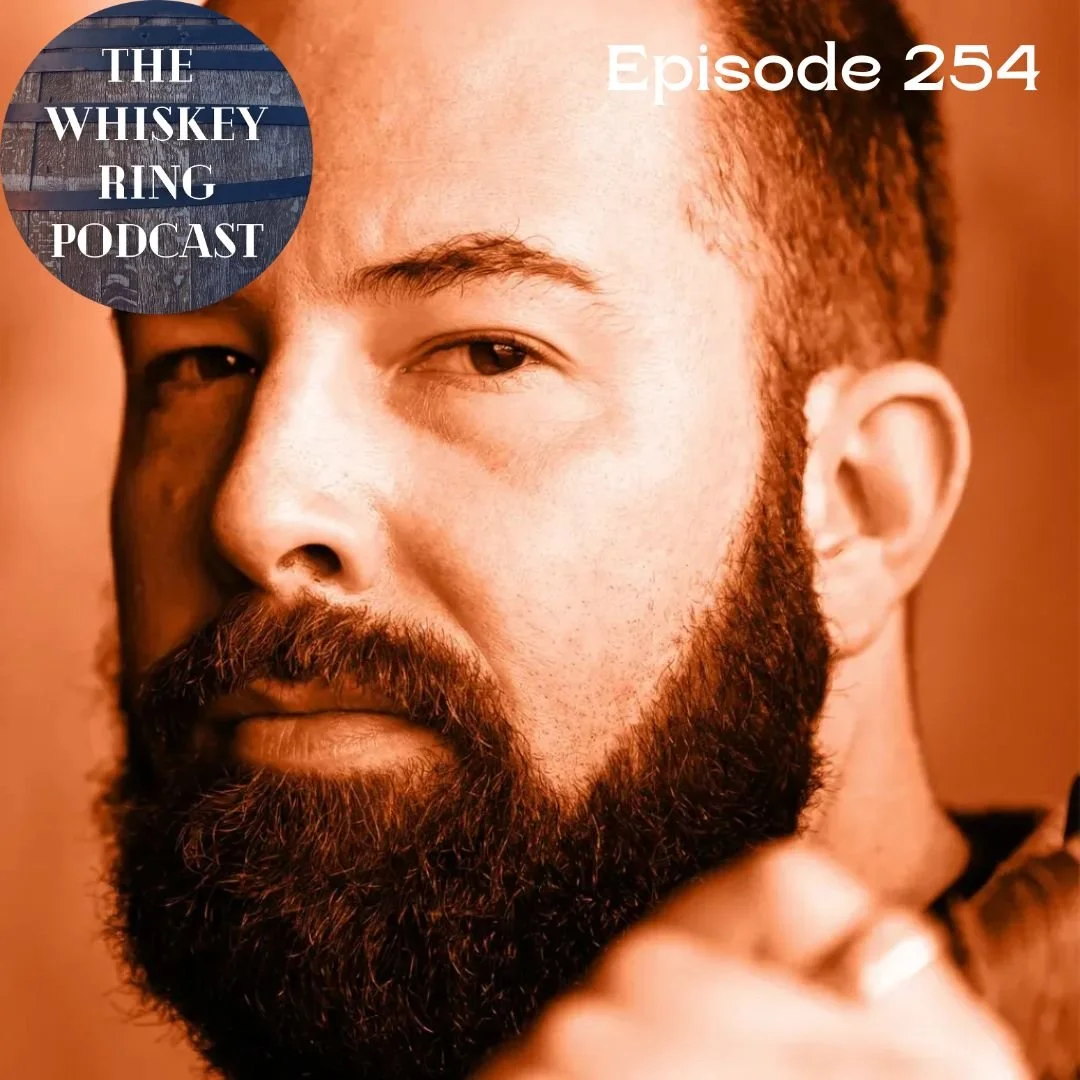
Episode 254: Chip Tate and Ampersand Spirits Show Notes
Chip Tate on Ampersand, Gambit No. 6, and the Next Chapter at Foley Family Wines & Spirits
Few people in American craft whiskey have had a career that refuses to stay in one lane quite like Chip Tate.
Founder of Balcones, still builder and copperworker, brewer, blender, distiller, student of fermentation, occasional brandy obsessive, and now Master Distiller for Innovation at Foley Family Wines & Spirits, Chip has spent close to two decades moving between the artistic and technical sides of spirits. I finally got to meet him in person a few weeks before this interview at the Kentucky Bourbon Festival, where he was carrying around samples of the newly released Ampersand Aureus. After spending hours listening to his voice while researching the episode, it was nice to finally attach a face to it.
We touch on Balcones because you can’t really talk about Chip without it, but I didn’t want to spend an hour reconstructing a story he has told many times before. I was much more interested in where all of those experiences have taken him now, particularly with Ampersand and Gambit No. 6, two projects that give him a fairly wide sandbox for thinking about blending, secondary maturation, fruit, wine, oak, and what exactly a finished whiskey can become when you stop treating the finishing barrel as a quick final flourish.
From Distilling to Copper and Back Again
After leaving Balcones, Chip spent roughly nine years working in copper, designing and building not only stills but much of the surrounding equipment. These were not decorative little pot stills either. Tate Craft Copperworks was building systems into the thousands of gallons, often with extremely thick copper and direct-fire designs that required the sort of physical work Chip now compares to trying to maintain a professional sports career well past the point your joints think it’s funny.
He’s largely out of still building now, although “not on purpose,” as he puts it. He still gets pulled into equipment conversations and has been involved with still design as part of Foley’s agave work in Oaxaca, where he’s also back to distilling.
Our discussion of direct fire gets into one of the threads that runs through almost everything Chip does. He likes traditional methods, but usually for a practical reason rather than simple nostalgia. With direct fire, the higher heating-surface temperatures can create Maillard reactions and flavor development that low-pressure steam does not replicate in quite the same way. We also circle back to Minden Mill’s hot-oil calandria system, which can reach similar surface temperatures without accepting all of direct fire’s inefficiencies.
Chip hasn’t distilled whiskey at Minden Mill yet, though he would like to. For now, the Nevada distillery has become particularly important on the maturation and blending side of his work.
His route into distilling was similarly indirect: brewing, cooking, some engineering experience, philosophy, seminary, education, fermentation, and eventually the realization around 2007 or 2008 that the parts of beer he found most interesting were increasingly pointing toward spirits. He had already spent years imagining a beer and then trying to engineer the recipe and process necessary to make it real. Distilling was another version of that exercise, with maturation added to the equation.
One line from Chip sums up a lot of his production philosophy nicely: you can ruin good spirit with a bad barrel, but you can’t fix bad spirit with a good one.
Ampersand and the House of Curiosities
Chip joined Foley Family Wines & Spirits in early 2024, and Ampersand was part of the conversation almost immediately.
The name fits the concept. Ampersand is about putting things together that normally occupy different boxes, most often somewhere around the intersection of fruit and grain. Chip describes it as his house of lovable curiosities, which is a much better description than trying to force all four releases under one conventional spirits category.
The first two ideas, Vinea and Malus, actually predated Foley.
Vinea may have the strangest origin. Chip had selected Cognac casks years earlier for another project and filled them with neutral grain spirit simply to keep the barrels wet and healthy. What was supposed to be perhaps six months or a year became roughly nine years, much of it sitting in a hot Texas warehouse near the copperworks. By the end, the liquid was dark, intensely tannic, deeply influenced by the old French oak and Cognac that had preceded it, and far too aggressive to use on its own.
So he used it almost like bitters.
Vinea combines 75% rye whiskey with 25% of that Cognac-cask-aged grain spirit. The supposedly neutral component is actually the louder part of the blend, bringing oak, fruit, tannin, and a slightly tropical quality rather than simply stretching the whiskey.
Malus takes the fruit-and-grain idea in another direction, pairing rye whiskey and Calvados almost evenly at 51% and 49%. There’s even a pleasing little bit of symmetry underneath it: the rye is a 95/5 mash bill, while the Calvados is approximately 95% apple and 5% pear. The apple brandy adds richness and freshness against the rye spice, along with a small Brettanomyces component that Chip describes as more spicy hay or leather than full-on wet horse blanket.
Malus was my favorite of the original Ampersand releases. I’m already predisposed toward Calvados, but rye and apple brandy make a lot of sense together when neither side is asked to disappear.
Opimus moves closer to recognizable finished bourbon territory, starting with 15-year-old Kentucky bourbon and using Tokaji casks to bring fruit back against an older whiskey that Chip found a little too tannic and angular on its own. Tokaji can range dramatically in sweetness and intensity, which opened a broader conversation about how little the phrase “finished in a Tokaji cask” actually tells you. What kind of wine was in it, how sweet was it, how active was the barrel, and how long did the whiskey stay there? Those details are difficult to fit onto a label, but they can completely change what ends up in the glass.
Then there’s Aureus, which had only just reached distribution when we recorded. It starts with Colorado bourbon from Peach Street Distilling, with an unusual 60% corn, 20% rye, 20% malted barley mash bill, then goes into Vino de Naranja casks selected in Spain. Vino de Naranja uses orange peel during aging, so some of that orange oil carries into the wood and eventually into the bourbon, giving Aureus its marmalade, honey, and dark citrus character.
I had a quick taste at KBF, and it was one of the pours that stayed with me from the weekend. Even at 60.9% ABV, it didn’t drink remotely like a bruiser.
Finishing, or Something Longer
One of the more interesting ideas in the episode is Chip’s reluctance to think of all of this as “finishing” in the usual American sense.
Finishing often implies a relatively short stay in another barrel after the primary maturation is complete. Chip is much more interested in long secondary aging, often 18 months, two years, or simply however long the whiskey needs before the cask has done what he wants.
That extra time lets the components interact rather than merely layering one recognizable flavor on top of another. He compares the French idea of élevage, raising a spirit, to raising a child. Maturation is not simply waiting for a clock to run out.
That philosophy becomes especially clear with Gambit No. 6.
Gambit No. 6 and Six Casks That Somehow Behave Themselves
I’ll admit that Gambit was the bottle I approached with the most skepticism and probably ended up enjoying the most.
Six different cask treatments can go very wrong very quickly. I’ve had plenty of multi-finished whiskeys where the underlying bourbon gets buried underneath a fruit basket full of competing barrel influences. Gambit somehow avoids that.
It starts with six-year-old Kentucky bourbon. About 15% goes into Cabernet Sauvignon casks and remains there until the final blend. Most of the rest first goes into stripped and re-toasted Chardonnay barrels before being divided among Oloroso, Muscatel, Tokaji, and Laird’s apple brandy casks.
Chip approaches the final blend almost like Bordeaux. Individual components are allowed to become somewhat exaggerated because they do not have to work alone. The Cabernet, for example, can become more vinous and angular because it is only one part of the eventual composition. His line that some casks are better “in a choir and not as a solo” is a good way of explaining it.
The apple brandy plays a particularly important role in stitching the other fruit components together, while the oxidative wines bring richer fruit, the Tokaji gives lift, and the Chardonnay barrels function as both a wine influence and a source of refreshed French oak.
Gambit is bottled at 92 proof, which I initially thought might make six different finishes even more obvious. Instead, the whiskey remains clearly present underneath them. I could go looking for individual pieces if I wanted to, but they read as a composition rather than six labels pasted onto the same bottle.
Chip compares it to a chord. Six notes played simultaneously can be noise, or they can be music. The hard part is choosing the right notes.
Craft Whiskey After the Boom
Toward the end, we return to something Chip was already talking about a decade ago.
In a 2016 interview, he was wondering what would happen after the first explosive wave of craft spirits: how early success stories would sustain themselves, how new producers would break through, what would happen when sourced whiskey tightened, and whether the enthusiasm around craft might eventually outrun the market.
Ten years later, the answer is considerably messier than anyone could have modeled.
COVID distorted demand, distribution and inventory in ways that are still unwinding. Some distilleries expanded into what appeared to be enormous demand, while others that relied heavily on tasting-room sales were starved of cash. Whiskey that was once difficult to source is now available in much greater quantities, creating both a problem for producers sitting on excess inventory and an opportunity for people who know what to do with mature stock.
That latter part is particularly relevant to Chip’s current work. At a moment when the industry hardly needs more barrels filled simply for the sake of filling them, Ampersand and Gambit let him begin farther downstream and ask what else existing whiskey can become.
He still wants to make whiskey from scratch again, and he’s actively distilling agave in Mexico, but he doesn’t see blending and finishing as some lesser half of the process. It’s work he has always done. Right now, it simply happens to be the part of whiskey offering the most interesting opportunities.
A Legacy Still Being Written
I asked Chip what he considers his legacy now, nearly two decades into distilling, and his first response was that he hopes the answer isn’t settled yet.
What he wants, eventually, is a body of spirits that are beautiful on their own and also add something to the traditions they come from. He has never seemed particularly interested in innovation purely because nobody has done something before. The more compelling version is knowing a tradition well enough to bend it without losing the thread entirely.
That describes the current work pretty well. Ampersand can get strange, Gambit can look borderline ridiculous when you list all six barrels on paper, and Chip is now splitting time between American whiskey projects and traditional Mexican spirits. Yet the through line is remarkably consistent: understand the raw material, understand the process, borrow useful ideas from wherever they come from, and make something that earns the experimentation once it reaches the glass.
There are easier careers than the one Chip Tate has chosen.
Then again, this is a guy who once decided five-eighths-inch copper and a sledgehammer sounded like a reasonable way to spend the day.
Chip Tate / Ampersand / Gambit No. 6
Foley Family Wines & Spirits: FFWS
Instagram: Chip Tate Whiskey
LinkedIn: Foley Family Wines & Spirits
If you haven’t joined the Patreon community yet, please consider doing so at patreon.com/whiskeyinmyweddingring
As of December 2025, the $25/month bottle share club level is sold out!
Join at the $5/month level for first shot at an open spot when a member retires and to keep receiving ad-free episodes via Patreon.
More Show Notes