Ep. 248: Still hollow Spirits with Athey Lutz Show Notes
Still Hollow Spirits: Athey Lutz on West Virginia Whiskey, Bloody Butcher Corn, and Mountain Spirits
This episode takes The Whiskey Ring Podcast to a new state: West Virginia.
I’m joined by Athey Lutz, founder, distiller, and ideas guy behind Still Hollow Spirits, a farm-to-bottle distillery in the Allegheny Mountains making corn whiskey, bourbon, rye, gin, botanical spirits, distilled IPAs, honey spirits, and the kind of deeply local products that make you remember how much American spirits history lives outside the usual handful of states.
Still Hollow is in Harman, West Virginia, on the Job Farm, down gravel roads and tucked into the mountains near some of the state’s most visited natural destinations: Seneca Rocks, Spruce Knob, and Blackwater Falls. It’s remote, but not empty. It’s out of the way, but not disconnected. As Athey puts it, Still Hollow is “a half hour from everywhere,” which is both a joke and a pretty good business model when the surrounding area is full of tourists looking for something real.
And Still Hollow is very real.
The distillery is built around spring water, Bloody Butcher corn, Appalachian moonshining traditions, local botanicals, local farms, and a production setup shaped by the practical realities of rural West Virginia. There’s no three-phase power at the end of that line. There are state laws that make distribution and tasting-room operations more complicated than they need to be. There’s a gravel-road pilgrimage built into the visit. There’s a dog named Ollie who apparently believes barking is another part of West Virginia culture.
Honestly, strong start.
A First Visit to West Virginia Whiskey
This was my first time covering a West Virginia distillery on the podcast, and I wanted to begin with place.
Still Hollow sits in the eastern part of West Virginia, near the borders of Maryland and Virginia, but very much in the mountains. The distillery is near Spruce Knob, the highest point in the state, and the region is full of spring water, farmland, steep roads, and natural beauty. That geography is part of the appeal now, but it was also part of why liquor was made there in the first place.
Remote hollows were good places to make whiskey quietly.
Before Prohibition, farmers in areas like this used distilling as a practical way to turn crops into something easier to transport and sell. You might not be able to load an entire corn crop onto a horse and drag it over multiple mountains, but you could turn that corn into a few barrels of whiskey and use it to buy the metal, sugar, cloth, or other goods your family couldn’t make at home.
Then came the coal and lumber boomtowns, with workers getting paychecks and demand for liquor rising right along with them. Prohibition didn’t end that tradition. It just pushed it deeper into the mountains.
For Athey, that culture was part of growing up in West Virginia. Not necessarily through a family distilling lineage, but through the people, stories, and practical knowledge around him. Still Hollow doesn’t pretend that moonshine history is a costume. It treats that history as an actual local inheritance, one tied to agriculture, economics, and survival.
From Environmental Consulting to Distilling
Athey didn’t grow up in a family of distillers.
He grew up around the culture, but his own path to Still Hollow took time. He was traveling for work as an environmental consultant, which is a familiar story in his part of West Virginia. Plenty of people grow up there, leave for work, and try to find their way back if they can.
Athey wanted to come home and build something in the place he was from.
That idea had been simmering for years. The economy around him had been shifting from an extractive economy, built around timber and other resource industries, toward tourism. His father had worked in the ski areas. Friends’ families were involved in outdoor recreation. Visitors were already coming into the area for the mountains, parks, and landscape, and they were fascinated by the moonshine culture.
The business idea was simple in the way good ideas often are: what if there were a legal, high-quality place where people could come experience that culture, taste spirits, learn how they were made, and support the local economy?
Athey and his wife, Maggie, took a class through Vermont Technical College to see what craft distilling looked like in practice. The class brought them to multiple distilleries each day, letting them talk with the people running them, study different business models, and understand the day-to-day reality of distilling for a living. They followed that with a course at the Siebel Institute in Chicago, which gave them a broader view of distillery operations through consultants and industry experts.
Those classes helped them answer the first big question: could this actually work?
The answer, eventually, became Still Hollow Spirits.
Distilling in West Virginia
When Athey and Maggie started looking seriously at opening a distillery, West Virginia only had a handful of operational distilleries. Athey remembered around three permits in the state at the time.
That’s changed. He said West Virginia is now somewhere in the twenties for distilleries, with a mix of moonshine, flavored moonshine, bourbon, whiskey, apple brandy, and other spirits. The scene is growing, and Athey described the distillers as friendly with each other, with events like the moonshine festival in Martinsburg helping bring the community together.
The state’s regulations, though, still shape the business.
West Virginia distilleries can’t operate like a bar in the way some distilleries can elsewhere. They can’t sell outside alcohol, which means the tasting room model looks different from states where a distillery might also run a full cocktail bar or restaurant built around a larger beverage program.
Still Hollow can sell bottles directly from the tasting room, but even that has a wonderfully strange bit of state machinery attached: Athey has to technically purchase the liquor online from the state before selling it in the tasting room so the state gets its cut. To sell to a bar or restaurant in West Virginia, he would need to send spirits to a state warehouse in Charleston, three and a half hours away, only for them to be redistributed back toward a liquor store much closer to the distillery.
That’s the kind of regulatory loop that makes you want to pour a drink and then check whether the drink is legally allowed to comfort you.
So Still Hollow’s growth has taken a different path. The tasting room matters. Tourism matters. Direct relationships matter. And now, online sales through Big Thirst matter, because they allow people who visited West Virginia, bought a bottle, and had their friends finish it two months later to order more without driving back down the gravel road.
Bloody Butcher Corn and West Virginia Whiskey
Still Hollow began with corn whiskey.
That choice came from taste, tradition, and practicality. In Athey’s part of West Virginia, there’s a long-running debate between corn and rye. Some people swear rye is smooth and corn is hot and hateful. Others will tell you the exact opposite with equal conviction and probably equal volume. Athey personally liked corn whiskey, so he followed that instinct.
The key was finding the right corn.
Still Hollow uses Bloody Butcher corn, an heirloom Appalachian variety with a deep history in the region. Athey found a strain that the same family had been growing for more than 200 years, and that corn had its own history of being made into moonshine. The idea was to make a real West Virginia whiskey from a simple base: the kind of clear corn liquor someone might have made a century ago if they were going the corn route rather than the rye route.
Still Hollow sells corn whiskey clear, but aging was part of the plan from the beginning. Early on, they used five-gallon barrels to get whiskey ready in about six months, while also filling 10-gallon barrels for one-year whiskey and 20-gallon barrels for two- and three-year releases. That gave them a way to start building aged whiskey while still having something to sell.
That’s the unromantic math every small distillery has to face. Whiskey takes time. Bills do not.
So Still Hollow also built out gins, flavored spirits, and botanical infusions. What started partly as a way to bridge the early years became a meaningful part of the portfolio, and Athey now sounds every bit as interested in those spirits as in the aged whiskey.
Ginseng, Chaga, Elderberry, Cranberry, and Mountain Flavors
One of the most interesting parts of Still Hollow is how it treats flavor.
These aren’t neon “moonshine” flavors built around candy logic. Athey is working with ingredients that actually grow in the area or have roots in Appalachian folk traditions: ginseng, chaga, elderberry, cranberry, black walnut, mint, horehound, and other botanicals.
The ginseng discussion alone could have been its own episode.
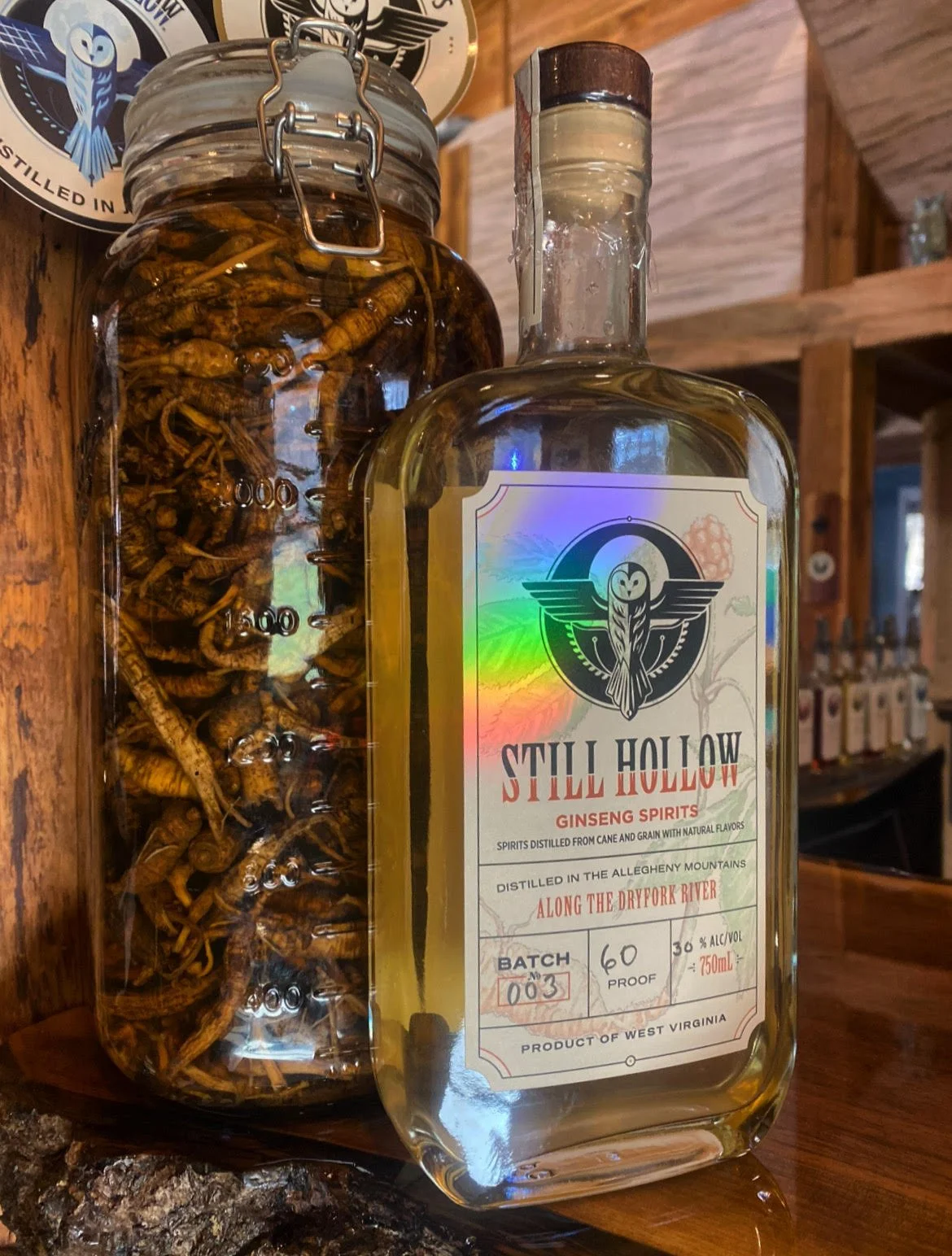
Photo credit: Still Hollow Spirits, Maggie Lutz
Ginseng has been a cash crop in the mountains for a very long time, with most of it ultimately shipped to Asia. It’s highly regulated, slow-growing, and valuable. Athey showed a jar of ginseng roots during the conversation and said it represented about $400 worth of ginseng, just a quarter pound. Some of the roots were 35 years old or older.
Still Hollow uses 190-proof corn alcohol for extraction, and Athey described the ginseng spirit as a double extraction. The roots soak in alcohol for around a year, then are boiled in water, and that water is used to proof down the spirit. The idea is to capture compounds that extract differently in alcohol and water. The flavor is earthy and bitter, as you might expect from something that spent decades growing in a mountainside, and Still Hollow balances it with local honey.
There’s also a federal quirk: if a spirit contains ginseng, it can’t be above 60 proof. Athey doesn’t know exactly why, and after hearing the explanation, neither do I. Apparently, ginseng gets a special seat in the odd regulation lounge.
Cranberry is another great example. Still Hollow uses cranberry because cranberries grow in high-elevation bogs in the region, about as far south as you’ll find them. Elderberry is deeply traditional too, appearing in jams, jellies, pies, and now spirits. Chaga and other medicinal mushrooms connect to the same Appalachian habit of using plants, roots, and herbs in alcohol as tinctures, tonics, and “grandpa’s medicine.”
Still Hollow can’t claim medicinal benefits, of course, but the cultural thread is obvious. If you’re going to flavor alcohol there, you put the real ingredient in the jar and let it speak.
The iStill, Rural Power, and Practical Distilling
Still Hollow’s production setup is built around an iStill, and it’s one of those equipment stories that tells you a lot about the distillery.
They started with a copper pot still over direct fire, which was affordable and certainly had the romance of sitting around a campfire watching the run. The problem was grain. Direct fire meant separating the grain before distilling, because even a little scorch can ruin a batch, and the risk only grows as volume increases.
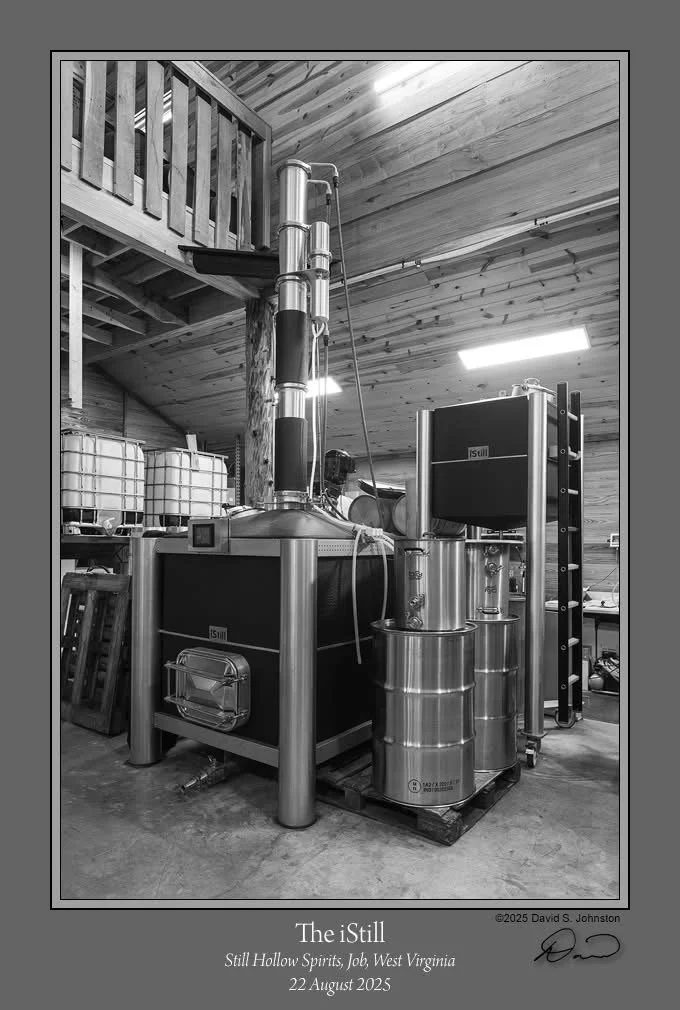
Photo credit: David S. Johnston via Still Hollow Spirits
The iStill solved several problems at once. It serves as masher, fermenter, and still. It’s stainless steel, electrically heated, temperature-controlled, and fitted with an agitator. Athey can mash on grain, ferment in the same vessel, agitate the solids back into suspension, and then distill without transferring everything through multiple pieces of equipment.
The process is straightforward, but not easy. Athey comes in the night before and fills the still with water. The next morning, he adds 750 pounds of Bloody Butcher corn. For the 100 percent corn mash, he uses enzymes because there’s no malted barley or rye to provide enzyme activity. He brings the mash up to about 190°F for corn gelatinization, cools it back down, adds another enzyme on the way down, then brings it to yeast temperature.
He uses champagne yeast and gets around 6 to 7 percent alcohol in the mash. Fermentation runs around 10 days to two weeks, with cold spring water running through the radiator to regulate temperature and keep the yeast from overheating itself into oblivion. After fermentation, he switches the iStill into distillation mode, runs the whiskey, cleans out the still, feeds the spent mash to cattle, and starts over.
The downside is that the same vessel can’t distill while it’s fermenting. At maximum, he can run it about once every two weeks. The upside is that it let Still Hollow avoid buying separate mashers, fermenters, and additional floor-space-consuming equipment.
There’s also the power issue. Still Hollow is at the end of the electrical line and doesn’t have three-phase power, so Athey runs the system with a phase converter. When he kicks it on, the lights dim. That pretty much rules out adding another electric still unless he changes the energy source.
Again, this is rural distilling in practice. The landscape gives you spring water, corn, tourism, and beauty. It also gives you electrical infrastructure that clears its throat loudly before cooperating.
Corn, Rye, Barley, and Champagne Yeast
The corn whiskey process differs from the rye and barley primarily in temperature and enzymes.
Corn has a higher gelatinization temperature and very low enzyme activity, even when malted. That’s why Athey brings the corn mash up so high and uses lab enzymes. With rye and barley, he doesn’t need to go as hot, and the malted grain brings its own enzyme activity. He can skip a whole chunk of heating and cooling because the grains behave differently.
Otherwise, the process is similar: gelatinize, cool, add yeast, ferment, distill.
The iStill itself gives Still Hollow flexibility. Athey described it as a liquid management still rather than a vapor management still. It’s open to the atmosphere at the top of the column and relies on condensation to keep vapor from escaping, which makes it a zero-pressure system. With enough cold water, there’s no pressure buildup. He can run it almost like a pot still for lower-proof, flavorful spirits, or choke it down to run vodka.
The catch is cleaning.
The column is packed with hundreds of pounds of little stainless steel springs, and if he made gin one day and whiskey the next, cleaning all that botanical character out would be a nightmare. So the iStill is used for whiskey, while the old copper still handles gin and other products where those flavors belong.
To get copper contact in the whiskey runs, Athey adds pure copper packing mesh into the bottom of the column before each run. That gives him fresh copper in the vapor path without the cleaning issues of a full copper system.
It’s not the romantic version of Appalachian distilling, but it’s smart, practical, and built around the constraints of the place.
The Local Audience and the Tourist Audience
Still Hollow has two audiences: locals and visitors.
The local reaction has been strong, though Athey gets the full range of feedback. Some people tell him he’s doing it wrong. Some people tell him it’s great. Some have regular bottles they come back for again and again.
That local support matters because the area had seen businesses disappear over time. The boomtown days of lumber mills and thousands of workers are long gone, and even the small corner stores closed decades ago. Athey was initially worried neighbors might be annoyed by traffic, but instead, one neighbor put up signs for the distillery at the intersection. People stop by just to talk. They bring visiting family and friends. Still Hollow has become one of the places you take people when they come to town.
The tourists, meanwhile, often arrive primed for discovery. They’ve driven the gravel road, they’re near Seneca Rocks or Spruce Knob or Blackwater Falls, and then they walk into a small distillery using spring water, local corn, mountain botanicals, and a still that looks more spaceship than moonshine shack.
Athey said the tasting room is now about 50/50 new customers and return customers, which is a great sign. The experience is sticky. People come once, then come back, then bring someone else.
That’s how a rural distillery grows: not through billboards, but through “you’ve got to see this place.”
Big Thirst, Online Sales, and Getting Beyond the Holler
For years, Still Hollow was essentially a come-to-us distillery. If you wanted the spirits, you had to visit.
That worked surprisingly well because of the tourist traffic, but it also created a problem. People from all over the country would visit, buy a bottle, go home, and then email a couple months later asking for more. Their friends had tried it. The bottle was gone. Could Still Hollow ship another?
Legally, Still Hollow can’t ship directly from West Virginia.
That’s where Big Thirst came in. Another West Virginia distiller, Mountain State Distilling, had already been working with them, and Big Thirst had a path through retail partners, including in Washington, D.C., where Still Hollow could distribute and then fulfill online orders through licensed retail partners.
That’s a big shift. It doesn’t replace the tasting room, and it doesn’t change the fact that Still Hollow is rooted in the physical visit, but it gives those relationships a way to continue after people leave West Virginia.
It also means the rest of us can actually try the spirits without needing to immediately plan a gravel-road pilgrimage, though, to be clear, I’m not opposed to the pilgrimage.
Distilled IPAs and Brewery Partnerships
Still Hollow’s distilled IPA releases are one of the strangest and most fun pieces of the portfolio.
The first partnership came through Stumptown Ales, thanks partly to a personal connection. Their brewer helped Athey wire up the still and install the burner in the early days, and the idea emerged to distill beer that wasn’t quite right for sale as beer. Sometimes a heavy IPA might stall out below its target ABV or miss the exact profile the brewery needed. The beer could still be good, but not right for that brand’s release.
Rather than dump it, Still Hollow distilled it.
Athey is honest that they didn’t know exactly how it would turn out. Distilling IPA concentrates hop oils, and those oils are extremely volatile. The whole building fills with intense hop aroma, and the clear distillate can be almost unpalatable unless you are an elite-level hop goblin. Barrel aging helps mellow the intensity, though the hop character never disappears completely.
The result isn’t whiskey under federal labeling logic, because the hops push it outside the category. It’s essentially a hoppy malt spirit, or as close as American spirits labeling allows to “what if IPA went through a still and came out weirdly charming?”
Still Hollow has also worked with Big Timber Brewing in Elkins, another local connection with family ties to sawmills, farming, and the broader regional economy. These partnerships fit Still Hollow’s personality well. They’re local, practical, a little odd, and rooted in not wasting something that still has value.
I love that kind of project because it only happens when producers are close enough to each other to solve a problem over conversation rather than through a formal product-development deck.
Distilled Mead and Honey Barrel Whiskey
Still Hollow has also distilled mead.
That came through another local friend who raises bees and makes varietal honey wines. Still Hollow picks up the honey wine, distills it, and barrel ages it. Athey called it the most expensive thing he’s ever distilled, which makes perfect sense. Honey is wildly expensive when you start thinking in barrel volumes rather than spoonfuls.
The same relationship led to honey barrel whiskey. Still Hollow provides five- and ten-gallon bourbon barrels to the honey producer, who uses them for bourbon barrel-aged honey. Then the barrels come back to Still Hollow and are filled with clear corn whiskey for about two years, creating a honey barrel-rested corn whiskey.
That’s the right kind of collaboration. It’s not honey flavoring tossed into whiskey. It’s a local producer, a shared barrel cycle, and a finished spirit that carries both parts of the relationship.
It also fits the broader Still Hollow pattern: use what’s nearby, respect the ingredient, and let the process stay visible.
Sustainability Without the Press Release Perfume
The sustainability side of Still Hollow feels unusually integrated because it grows out of necessity as much as philosophy.
Athey’s background in environmental consulting shows up, but the distillery’s sustainability practices also connect to older Appalachian habits of using what you have and wasting as little as possible. The spent mash goes to cattle. Local ingredients support local farms. Spring water is central to production. The farm grows Bloody Butcher corn onsite, and Still Hollow’s own site notes its 10kW solar array, water reuse, local materials, and focus on supporting the local economy.
None of that feels like greenwashing pasted onto the side of a bottle. In a place like this, sustainability is less of a marketing mood and more of a survival skill with better vocabulary.
The old moonshiners were not wasting resources because they were operating on slim margins in hard places. Still Hollow takes that same practicality and folds it into a modern, legal, farm-based distillery.
What Still Hollow Is Trying to Preserve
The legacy question closed the episode, and Athey’s answer was exactly where the conversation had been pointing.
He wants Still Hollow to help people understand the importance of high-quality ingredients, authentic production, and looking past labels to see whether a spirit is actually distilled by the person selling it or simply rebranded from somewhere else. More broadly, he wants people to support small producers who put real energy into what they make, whether that’s Still Hollow or a distillery in their own state doing similar work.
That’s a good legacy.
Not every distillery needs to become a national brand. Some distilleries are most valuable because they give shape to a place. Still Hollow is one of those. It explains something about West Virginia by putting it in a glass: corn from the mountains, spring water, ginseng, elderberry, cranberry, local farms, gravel roads, old traditions, modern equipment, awkward regulations, and a tasting room people bring their friends to because there’s nothing quite like it.
Athey also put it simply: if Still Hollow can give people something high-quality to drink with family and friends, and bring a little cheer into their lives, that’s the goal.
There are worse reasons to build a distillery.
What This Episode Is Really About
This episode is about Still Hollow Spirits, but it’s also about the kind of distillery that can only exist where it exists.
You can’t lift Still Hollow out of West Virginia and drop it somewhere else without losing the thread. The roads matter. The spring matters. The corn matters. The old moonshine culture matters. The tourists matter. The local regulars matter. The ginseng roots matter. The iStill and the phase converter and the lights dimming when the equipment kicks on all matter too.
This is American craft distilling at its most grounded: not polished into sameness, not trying to imitate Kentucky, not leaning on a fake family moonshine myth, and not pretending small production is easy. It’s a distillery built from practical decisions, local ingredients, and a stubbornly specific sense of place.
I’m glad Still Hollow is now a little easier to find outside the holler, and I’m even more glad the holler is still the center of it.
Still Hollow Spirits
Website: https://stillhollowspirits.com/
Shop: https://stillhollowspirits.com/shop/
Our Spirits: https://stillhollowspirits.com/our-spirits/
Sustainability: https://stillhollowspirits.com/sustainability/
Facebook: https://www.facebook.com/stillhollowspirits/
Instagram: https://www.instagram.com/stillhollow/
If you haven’t joined the Patreon community yet, please consider doing so at patreon.com/whiskeyinmyweddingring
As of December 2025, the $25/month bottle share club level is sold out!
Join at the $5/month level for first shot at an open spot when a member retires and to keep receiving ad-free episodes via Patreon.
More Show Notes