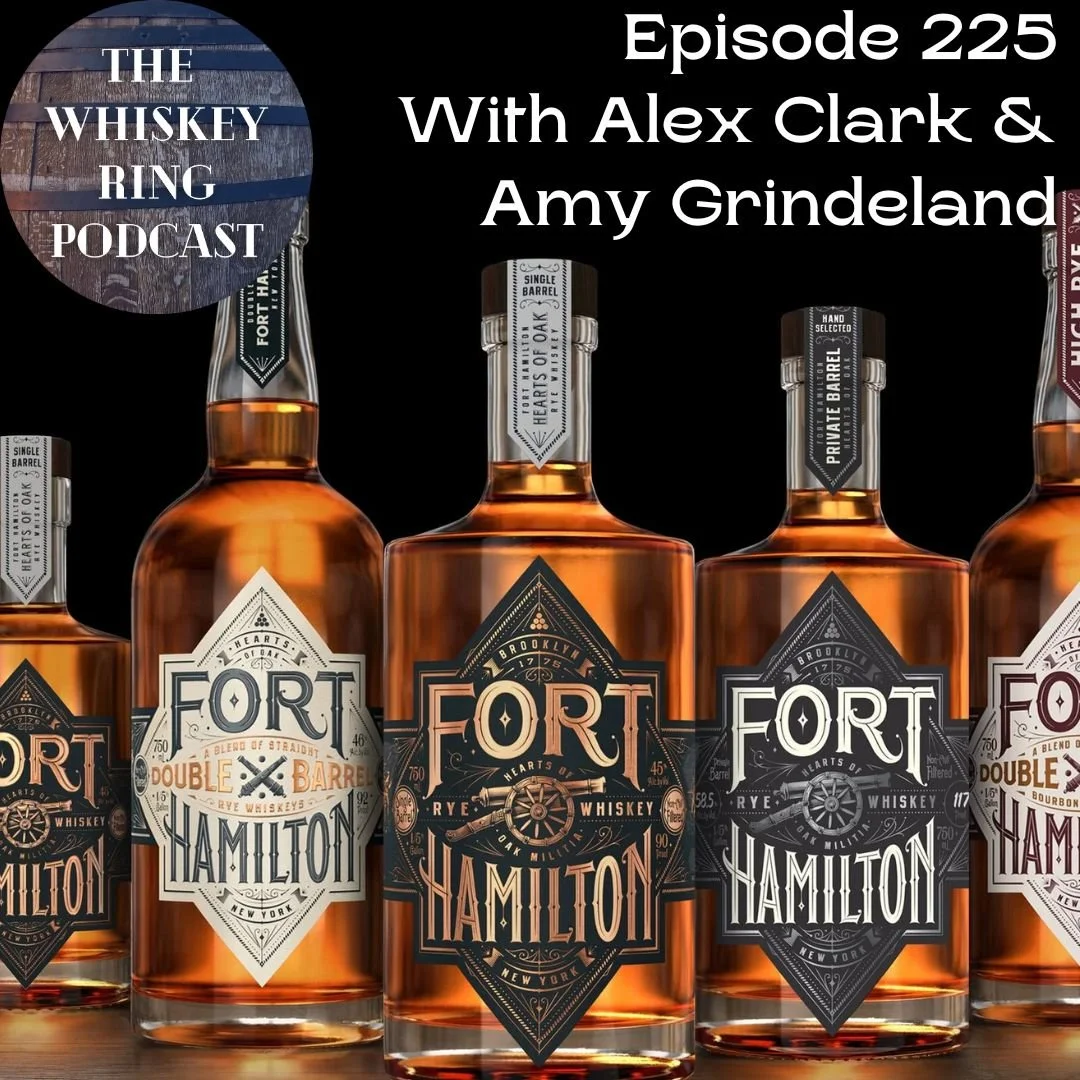
Fort Hamilton Distillery with Alex Clark and Amy Grindeland Show Notes
Fort Hamilton Distillery: Revolutionary Rye, Brooklyn Grit, and the Long Game
Five years is long enough for a whiskey to change.
It’s also long enough for a distillery to prove it wasn’t bluffing.
When I first visited Fort Hamilton Distillery in March 2021, the world was still half-shuttered. The tasting room was poised to open, the rye was the beating heart of the brand, and the bourbon had just joined the lineup. It felt like momentum paused mid-stride.
Fast forward to today, and that stride has turned into a steady march.
On this episode, I sit down again with co-founders Alex Clark and Amy Grindeland to talk about growth, grit, and what it means to build a distinctly New York whiskey brand without chasing every shiny object in the room (with a closing tease towards their 10th anniversary!)
Building a New York Rye the Old Way
Fort Hamilton was never meant to be just another craft label with a sepia-toned backstory. Alex’s obsession from the beginning was specific: recreate a true Northeastern rye whiskey, the kind that would have been poured in Manhattan (or Valley Forge) out of a barrel in the 1700s and cocktails in the mid-to-late 1800s.
At the time he was bartending in New York, there was essentially one rye on the shelf, even at the top restaurants and cocktail pioneers. And it wasn’t the historic, corn-free Monongahela style that would have fueled early American bars. It was Kentucky-made rye using mid-Atlantic and Northeastern brand names, divested of their rye and, frankly, their soul. Old Overholt was available…Rittenhouse wasn’t yet in New York. That absence became the spark.
Today, Fort Hamilton’s flagship New York rye sits at 90% rye and 10% malted barley. No corn. No shortcuts. A deliberate nod to historic mash bills from the Northeast. Notably, it’s also not an “Empire Rye” as designated by New York State. It could be, but that omission, too, is deliberate - listen to Alex explain why in the podcast.
But recreating a style without surviving bottles from the 1700s or even mid-to-late 1800s is part archaeology, part intuition. There are no detailed mash logs from 1766 Brooklyn. No yeast charts. No barrel-aging manuals. What exists is context.
That context led to 30-gallon barrels instead of modern 53-gallon standards. Before forklifts, smaller barrels were practical. Portable. Realistic. So that’s where Fort Hamilton planted its flag.
Add to that something few people consider: warm winter aging. Historic Pennsylvania and New York rickhouses were often heated, especially once steam heating became commonplace. Today, Industry City’s steam system keeps their barrels warm through brutal New York winters. The result is whiskey that develops differently, often tasting mature beyond its years. What was once meant to create aging parity with Kentucky is now a hallmark all its own.
It’s not manufactured history. It’s informed revival.
Industry City: Concrete, Steam, and Soul
If you’ve never been to Industry City in Brooklyn, imagine cavernous concrete buildings built to move railcars straight from dock to warehouse floor. It is industrial in every sense of the word.
And yet, inside Fort Hamilton’s tasting room, it feels warm.
Amy deserves much of that credit. What could have been austere instead feels inviting. Intentional. Designed. The contrast between thick concrete floors and a welcoming bar is part of the magic. The times I’ve visited, be it mid-COVID with nobody there or during Bar Convent Brooklyn when every industry professional in the area is there, it’s a space separate and above, a respite from the bustle outside.
This is not a distillery pretending to be pastoral. It leans into Brooklyn without the pretension. As one of the last two independent distilleries in New York City (the other being Kings County), they can be exactly what they want.
Owning the Backyard
Fort Hamilton now sells well over 10,000 cases annually, up from roughly 1,000 around the time of my first visit. That growth hasn’t come from blitzing all 50 states.
Instead, it’s come from running narrow and deep in New York.
Roughly 94% of their business remains in-state. That focus allows them to build presence in bars and restaurants first. The philosophy is simple and slightly old-school: if someone enjoys your whiskey in a cocktail, they’ll seek out the bottle later.
It’s not glamorous expansion. It’s durable expansion.
And in a whiskey market that’s wobbling under overproduction and easy-money hangovers, durability matters. Selling bottles is great - but if people don’t come buy a second, or if they want to buy but you don’t have enough to supply your distributor with more, they’ll go somewhere else, and regaining that patronage is both expensive and unlikely.
Bourbon, Balance, and Not Getting Distracted
For a brand born of rye revivalism, it might surprise some that their New York bourbon has become a quiet powerhouse.
The five-year single barrel bourbon earned 95 points and landed in Wine Enthusiast’s Top 100 Spirits of 2024. Not bad for a distillery that could have leaned entirely into one identity.
Still, there’s discipline here. No RTDs. No single malt—they thought they might for awhile, but alas, not for now. No frantic category hopping. And why would they? Between two whiskies (plus variations) and fast-selling white spirits, there’s no need to add just for the sake of adding.
They’ve worked hard to get these products into these bottles. Now is the time to sell them, not distract from them.
The Gin That Shouldn’t Work (But Does)
If the rye is history-driven, the gin is culinary.
The Fort Hamilton New World Dry Gin uses fresh watermelon and cucumber, inspired by the fact that the first musket shots of the Battle of Brooklyn were fired in a watermelon patch just blocks from the distillery.
But the real breakthrough came when gin stopped being treated like a spice rack and started being treated like a kitchen. It took a year to get this right - nobody was making watermelon gin, so there was nobody to ask, just trial after trial.
Fresh citrus instead of dried. Orange paired with coriander, cinnamon, and star anise. Multiple failed batches. Scaling headaches from 10-gallon test runs to 100-gallon production runs. Even learning the hard way that orange oil content changes seasonally.
The result is a gin that’s richer, rounder, and un-chill-filtered. A spirit people claim to dislike until they taste it. This is one of my favorite gins to sip neat, bringing a flash of summer to the palate.
And crucially, gin provides cash flow. Cash flow keeps whiskey aging. Whiskey aging builds the future.
The Full Circle Manhattan
The original frustration that sparked Fort Hamilton was simple: you couldn’t make a historically accurate Manhattan without historically styled rye. When you’re like Amy and Alex, who “grew up” in the circles of Balthazar, Marea, and, of course, the teams at the legendary Milk & Honey, a just-fine or even pretty good Manhattan wasn’t enough. It had to be the real thing - and to make the real thing, they made the real thing.
Now, nearly a decade in, you can walk into their tasting room and order a Manhattan built on six-year New York rye made in that revived style.
That’s the long game paying off.
Revolutionary, Lowercase and Uppercase
The name Fort Hamilton carries weight. It’s rooted in Revolutionary War history, in Brooklyn geography, in a real place that still stands.
There’s irony in an English-born founder building a Revolutionary-themed American whiskey brand. They lean into that. History here isn’t mythmaking. It’s contextual. It’s documented. It’s part of the ground they stand on.
And after ten years of careful production, measured growth, and deliberate decisions, the brand feels less like a startup and more like a fixture. They’ve brought on more distillers, more staff, and the sales talent to expand exactly how they want to (shout-out to NYC star Savannah Burnett, recently of Bardstown Bourbon Company).
The revolution, it turns out, is bringing into existence the history that disappeared. And it comes at the rye-t time.
If you haven’t joined the Patreon community yet, please consider doing so at patreon.com/whiskeyinmyweddingring
As of December 2025, the $25/month bottle share club level is sold out!
Join at the $5/month level for first shot at an open spot when a member retires and to keep receiving ad-free episodes via Patreon.
If you haven’t yet, please follow Whiskey in my Wedding Ring and the Whiskey Ring Podcast on Instagram and Facebook and subscribe to the newsletter on the website.
Fort Hamilton Distillery