Painted Stave Distillery with Mike Rasmussen Show Notes
Painted Stave Distilling: Delaware Whiskey, Movie-Theater Origins, and a State’s Distilling Revival
Delaware isn’t the first state most people associate with whiskey. Beer, sure. Dogfish Head made sure of that decades ago. But distilling is a quieter story.
So when I sat down with Mike Rasmussen at Painted Stave Distilling in Smyrna, Delaware, we started with a simple reality: the Whiskey Ring Podcast had never visited Delaware before.
That’s partly because for a long time, there simply weren’t many distilleries to visit (there are now just two, Painted Stave included). Painted Stave didn’t just open a distillery in Delaware during the early craft boom. They helped make it legal to do so.
Today the distillery sits inside a restored movie theater in downtown Smyrna, producing everything from bourbon and rye to a distinctive pot still whiskey and a growing lineup of experimental releases. But the story of how it got there begins well before the stills ever arrived.
Two founders and a craft movement just beginning
Painted Stave didn’t start with moonshining family lore or inherited distilling equipment.
Mike Rasmussen came from a public policy background, while his co-founder Ron had spent years as a scientist conducting cancer research. Both loved spirits, and both had started noticing the earliest waves of craft distilling appearing in the late 2000s. Independently, they began wondering whether building a distillery might actually be possible.
At the time, craft distilling knowledge was thin. Most books focused on home distillation. Few small distilleries existed, and fewer still were sharing detailed production advice.
So like many early craft distillers, they started learning the only way available. They visited distilleries, asked questions, attended industry conferences, and spent as much time as possible talking with other producers who were figuring things out in real time.
Connections through the American Distilling Institute and conversations with people like Dave Pickerell helped shape their early thinking about equipment, production, and what a small distillery could realistically accomplish.
But before they could distill anything, they had a more basic problem.
Distilling spirits in Delaware wasn’t actually legal yet.
Writing Delaware’s craft distilling law
When Rasmussen and his partner began planning Painted Stave around 2011, Delaware didn’t have a modern craft distilling license.
So the founders helped write one.
Working with lawmakers and industry allies, including Dogfish Head Craft Brewery, they helped craft legislation that would allow small distilleries to operate in the state. Compared with the multi-year fights seen in places like New York or Pennsylvania, Delaware’s process moved quickly.
The legislation passed in roughly twelve weeks.
Only then could the distillery actually begin taking shape.
Turning an abandoned movie theater into a distillery
Finding the right location ended up being as unusual as the legal process.
Instead of settling into an industrial warehouse, the founders restored a long-abandoned movie theater in downtown Smyrna. The building had been sitting unused for years, and the town was eager to find a new use for it.
Local leaders actively encouraged the distillery project, introducing Rasmussen and his partner to community members and making it clear that the town wanted the distillery to succeed.
The result is one of the more distinctive distillery spaces in American craft spirits. The still sits where theater seats once sloped toward the screen, while the building’s former projection areas now house offices and additional event space.
More than a decade later, the distillery draws roughly 20,000 visitors each year to a town that had just a few thousand residents when the project began.
The story behind the name Painted Stave
The name Painted Stave came from an unexpected place: historical research in the University of Delaware archives.
While digging through old newspapers and regional history, Rasmussen found a reference to a clever signal used during pre-Prohibition dry laws. A painted barrel stave placed outside a building could quietly signal that alcohol was available inside. Turn the stave inward and the shop was closed.
The image stuck.
Today painted staves appear throughout the distillery, and the concept has even evolved into a community art project where local artists paint reclaimed barrel staves that are later auctioned to support education initiatives.
A distillery built around variety
From the beginning, Painted Stave was never intended to focus on just one spirit.
Gin and vodka helped support the business while whiskey aged, but the founders always envisioned a broad lineup. That philosophy still defines the distillery today.
Their portfolio includes bourbon, rye whiskey, pot still whiskey inspired by historical Irish styles, American single malt releases, and a range of experimental mash bills and specialty barrels.
The idea isn’t simply to replicate classic whiskey styles. Instead, Rasmussen describes the approach as creating spirits that work both neat and in cocktails, balancing distinctive flavors with versatility behind the bar.
Building a Delaware style bourbon
One of the distillery’s defining releases is its bourbon, built around a notably high-rye mash bill of roughly 66 percent corn, 26 percent rye, and 8 percent malted barley.
That extra rye adds spice and structure, allowing the whiskey to stand up in cocktails like Manhattans or Old Fashioneds while still maintaining a rich sweetness from the corn base.
The bourbon ages in heavily charred 30-gallon barrels, which increases wood interaction and helped the distillery build mature stocks earlier in its life. As the distillery has aged, those barrels have gradually stretched into longer maturations, with some now approaching the ten-year mark.
A small distillery with room to experiment
Painted Stave remains a relatively small operation, with a few hundred barrels aging on site.
That scale creates space to experiment. Rasmussen regularly explores unusual mash bills, one-off releases, and small experimental batches that give returning visitors something new to discover.
Those experiments have included 100 percent rye whiskey, American single malt projects, unusual multi-malt mash bills, and upcoming brandy releases inspired by Delaware’s historic fruit-growing traditions.
For a small distillery, that flexibility is part of the appeal.
Reviving Delaware’s distilling tradition
Delaware once had a stronger distilling presence than many people realize, particularly through apple and peach brandies produced during the eighteenth and nineteenth centuries.
By the early twentieth century that tradition had largely disappeared.
More than a century later, Painted Stave is helping rebuild it.
Not with massive warehouses or industrial production lines, but with a restored movie theater, a few hundred barrels, and a willingness to experiment in a state that rarely shows up on the whiskey map.
Sometimes the revival of a whiskey tradition starts quietly, with a painted stave outside the door and a distillery bringing the craft back to life.
If you haven’t joined the Patreon community yet, please consider doing so at patreon.com/whiskeyinmyweddingring
As of December 2025, the $25/month bottle share club level is sold out!
Join at the $5/month level for first shot at an open spot when a member retires and to keep receiving ad-free episodes via Patreon.
If you haven’t yet, please follow Whiskey in my Wedding Ring and the Whiskey Ring Podcast on Instagram and Facebook and subscribe to the newsletter on the website.
Painted Stave Distillery
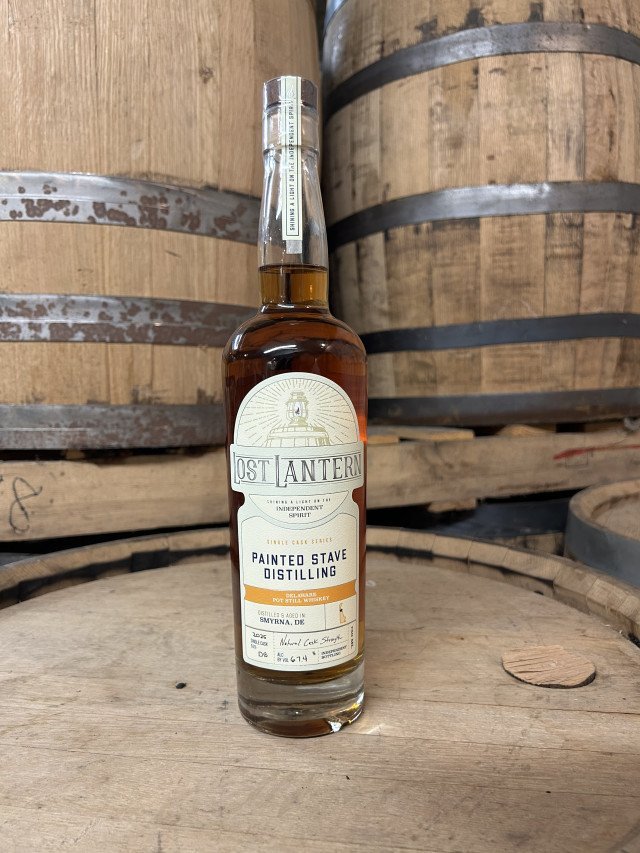
Photo credit: Lost Lantern
This is Lost Lantern’s first pot still-style whiskey release. It was aged for five years in 30 gallon casks that previously held Painted Stave’s own rye whiskey.
Lost Lantern Single Cask Painted Stave Pot Still Whiskey: Specs
Classification: Delaware Pot Still Whiskey
Producer: Painted Stave Distillery
Mash Bill: 70% Unmalted Barley, 10% Malted Barley, 10% Beechwood-Smoked Malted Barley, and 10% Rye
Proof: 134.8º (67.4% ABV)
Age: 5 Years Old
Location: Delaware
Lost Lantern Single Cask Painted Stave Pot Still Whiskey Price: $100
Lost Lantern Single Cask Painted Stave Pot Still Whiskey: Tasting Notes
Eye: Wildflower honey. Thin rims, thin legs, hang-on drops.
Nose: Walking into Home Goods at Christmas. Sweet cinnamon and pine, diverse floral notes around the edges. Freshly grated nutmeg, nutty and floral all on its own. Alder is a flavor all by itself, too.
Palate: Baking spices first, led by that fresh nutmeg, turning from sweet to savory as the pepper spice grows on the front tongue. The woodsmoke influence is tampered by proof and sweetness, like black pepper smoky caramels. The 10% rye is a great balance, doesn’t need a lot of power, just enough. Mouthfeel is front-tongue, piquant, leathery on the middle with Fig Newtons, moderate body, and oily while textured.
Finish: The alder sneaks up, overtaking the nutmeg in a scent woodsmoke that gradually coats the whole palate. Barest numbing sensation. Medium length, drying.
Overall: The profile is totally new to me - each part is familiar, but not as a whole. I need more time with this to fully appreciate the nuances. I’m impressed that this isn’t overoaked with 5 years in a 30 gallon barrel - the astringency is mild at most. The woodsmoke is pleasantly fragrant. It’s the Home Goods at Christmas note that gets me, though.
Final Rating: 7.4
10 | Insurpassable | Nothing Else Comes Close
9 | Incredible | Extraordinary
8 | Excellent | Exceptional
7 | Great | Well above average
6 | Very Good | Better than average
5 | Good | Good, solid, ordinary
4 | Has promise but needs work
1-3 | Let’s have a conversation