Ep. 242: Warfield Distillery with Alex Buck Show Notes
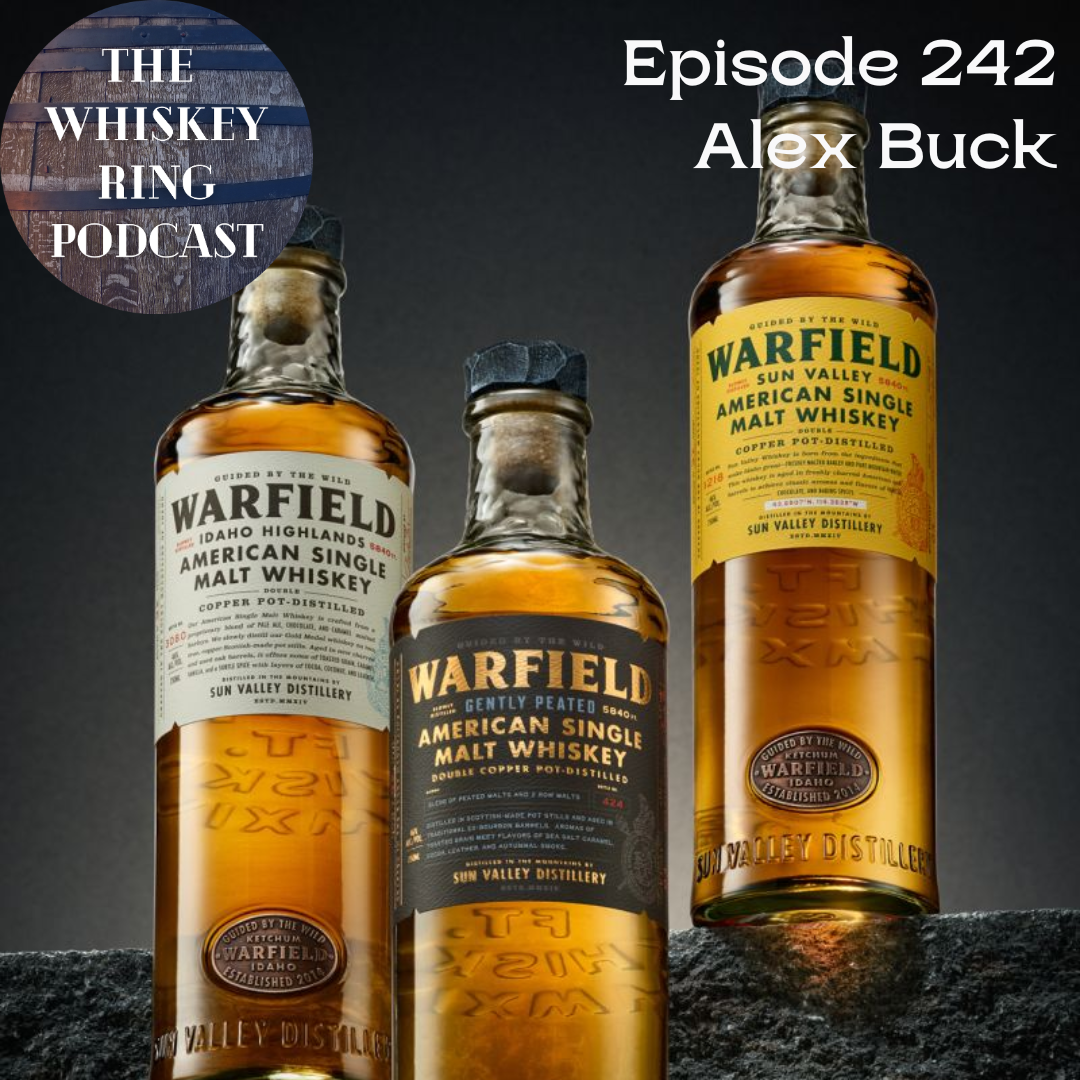
Warfield Distillery: Idaho Highlands, American Single Malt, and Whiskey Above a Mile High
This episode takes the Whiskey Ring Podcast somewhere new: Idaho.
More specifically, we’re heading to Ketchum, Idaho, home of Warfield Distillery and its American single malt whiskeys made under the Sun Valley Distillery umbrella. Idaho might still be better known for potatoes than pot stills, but that is part of what makes Warfield such an interesting stop. There is no long-established Idaho whiskey template to copy. There is barley, altitude, mountain water, a control-state regulatory system, and a distillery trying to make something that belongs to the Idaho Highlands.
I’m joined by Alex Buck, co-founder, managing distiller, and partner at Warfield. Alex came to whiskey through beer, cask ale, Scotland, and a stubborn refusal to make the obvious thing. In 2014, most small American distilleries reaching for whiskey were making bourbon or rye. Warfield chose 100% barley, used cooperage, and a Scottish-style approach before American single malt had the regulatory clarity and consumer momentum it has now.
That was not necessarily the fastest commercial path.
It was the path that made sense for Ketchum.
Warfield, Sun Valley, and the Idaho Highlands
One of the first clarifications in the episode is the naming.
The brand on the bottles is Warfield. Sun Valley Distillery is the LLC behind it. If someone says “Sun Valley Distillery whiskey,” they are not necessarily wrong, but Warfield is the name that matters on the shelf.
The location matters even more.
Warfield sits in Ketchum, near Sun Valley, at roughly 5,840 feet above sea level. That makes it one of the highest-elevation distilleries in the country, even if Breckenridge may still have the top claim there. More important than the ranking is what that elevation does. Warfield lives somewhere between alpine and high mountain desert: low humidity, temperature swings, sage, snow, mineral water, and a climate that can push barrels hard.
That is why “Idaho Highlands” works as more than a label phrase. Warfield is making American single malt in a place where local barley, mountain water, and high-altitude maturation all shape the whiskey.
Why Idaho, and Why Not Bourbon?
Alex and his wife left California with young twins and a desire to build something different. They loved spirits, beer, and mountain towns, and Idaho eventually won out over other possible destinations.
From the beginning, the distilling idea was tied to the local agricultural landscape. The Bellevue Triangle grows barley, much of it for major beer producers. Corn, on the other hand, was not the obvious local grain. So why force a bourbon identity onto a place that was already telling a different story?
Alex also felt the bourbon market was already crowded, even then. Bourbon might have sold more easily in the short term, just as IPAs might have sold more easily on the beer side. Warfield made neither.
That stubbornness is a recurring theme in the episode.
Warfield was built around the long game: barley, ex-bourbon casks, patience, and the belief that American single malt would eventually catch up to what the distillery was already doing.
Beer First, Whiskey Always
Warfield began as a brewery-distillery-restaurant, and brewing arrived first.
That was not because whiskey was an afterthought. It was because whiskey takes time, and beer could generate cash flow while barrels were aging. Alex was the head brewer, head distiller, and, by his own admission, a reluctant restaurant manager. The restaurant was partly a business model and partly a regulatory artifact, since Idaho rules at the time made the brewpub/distillery structure more practical.
The brewing background still runs through the whiskey.
Alex came to beer through a love of UK cask ales, especially the way barley can create flavor without needing to shout. That brewer’s eye for malt carries into Warfield’s American single malt program. The whiskey starts as beer, and Alex is clear about one thing: if bad flavor goes into the still, more concentrated bad flavor comes out.
That seems obvious. It is not always treated that way.
Warfield approaches the wash with a brewer’s cleanliness and attention to fermentation. A lager leaves nowhere to hide. Alex applies a similar logic to whiskey.
Idaho Distilling and the Control State Puzzle
Idaho is a control state, which creates both friction and opportunity for small distilleries.
The regulatory landscape can be complicated because liquor-by-the-drink licensing, state stores, and on-premise/off-premise rules do not always overlap cleanly. But Alex describes Idaho as generally supportive of in-state distillers. People answer the phone. Regulators are accessible. The Idaho State Liquor Division has an incentive to support local products, and the control-state system can limit the ability of huge brands to simply drown out smaller players.
The Idaho distilling scene is still relatively small, but it is not empty. There is an Idaho Distillers Association, larger neutral-spirit production in the state, and a handful of smaller producers working in different directions.
Warfield occupies a very particular lane within that world: brewery roots, American single malt, gin, and a mountain-town identity.
From a 210-Gallon Pot Still to Forsyths Copper
Warfield’s earliest whiskey came from a 210-gallon copper pot still made in Olympia, Washington. At that scale, filling a single 53-gallon barrel took roughly two weeks.
That is real commitment to full-size barrels.
From the beginning, Warfield avoided the shortcut of small cooperage. The whiskey went into 53-gallon ex-bourbon casks, closer to the Scotch and Irish traditions that inspired Alex than the small-barrel craft whiskey trend of the 2010s.
The production picture changed in 2020 when Warfield brought in two 1,000-gallon Forsyths copper pot stills. The timing was exquisite, in the way 2020 was exquisite for anyone opening or expanding anything. Suddenly, Warfield had a serious whiskey setup in the middle of a global “what now?” moment.
The stills were sized deliberately, falling somewhere between the tall elegance of Glenmorangie and the heavier profile of Macallan. The goal was neither featherlight nor oil-drenched. Warfield wanted balance: enough reflux for refinement, enough body for texture.
Today’s core whiskeys are coming from those Forsyths stills. Some older stock from the original still remains, including barrels around nine-plus years old, but the current brand identity is largely built around the larger stills and the production capacity they unlocked.
American Single Malt Before the Category Caught Up
Warfield started making American single malt before American single malt had the same clarity and visibility it has now.
That led to the wonderfully clunky early labeling phrase “whiskey made with barley mash,” because the regulatory language had not yet caught up with what producers like Warfield were doing.
The idea was always clear, though: 100% barley, pot distilled, matured primarily in used cooperage, and built around the interplay of malt character, cask, and place.
That choice helped Warfield avoid the bourbon comparison trap. Instead of making a young craft bourbon and asking consumers to grade it against Kentucky, Warfield built something closer to Scotland in structure but rooted in Idaho.
It is Scottish-style in influence, not imitation.
Idaho Barley, Non-GMO Flexibility, and the Organic Shift
Warfield originally leaned heavily into organic production, and some liquid in the current lineup still comes from those certified-organic production runs. Over time, though, the distillery moved away from the Idaho organic seal.
The reason was not a loss of interest in quality or sourcing. It was flexibility.
Alex wanted access to non-GN barley, especially with an eye toward broader markets and the standards used in Scotland, Ireland, and Europe. Organic non-GN barley was not readily available in the U.S. at the scale and consistency Warfield needed. So the distillery made a choice: preserve the more important long-term grain standard rather than stay boxed into a certification that limited options.
That is a very Warfield decision. Practical, quality-driven, and connected to where the brand wants to go.
The core mash bill uses two-row barley with specialty malts such as crystal and chocolate malt. For the Gently Peated whiskey, the peated portion comes from Scotland, with heavily peated malt from Crisp, blended with Idaho barley. Alex would love local identity wherever possible, but peat is its own animal. Just because a place has wet ground does not mean it has peat you can harvest, smoke, and enjoy in whiskey.
Sometimes the right traditional ingredient comes from people who have been doing the job for centuries.
Fermentation, Yeast, and the Clean Wash Philosophy
Warfield uses Lallemand DistilaMax yeast and pushes the wash into the 12 to 13.5% ABV range, which is high for a pre-distillation wash.
That high number is less about altitude wizardry and more about brewing precision. Head brewer Josh Strobel has dialed in the whiskey wash with impressive efficiency, extracting what the grain can give without simply loading the mash tun past the point of usefulness.
Alex has experimented with other yeasts, including brewing yeasts and organic options, but beer yeast can struggle at those higher ABVs. Some strains stall around 9 or 10%, leaving residual sugar, lowering yield, and complicating the process.
That does not mean yeast experimentation is off the table. It means Warfield’s process is built around a clean, reliable fermentation that gives the stills a wash worth distilling.
Again, the brewer’s brain shows up. Fermentation is not something to endure until distillation starts. It is where much of the final whiskey begins.
Clear Wort, Clean Flavor, and No Place to Hide
Warfield favors a clear wort process rather than distilling on grain.
Alex’s reasoning is straightforward. Over-steeped or over-boiled grain can create off flavors, and those off flavors do not magically disappear because the liquid went through a still. They concentrate. They linger. They become the thing you later pretend was intentional.
That contrasts with distilleries deliberately chasing on-grain, wild, or heavier styles, and there are excellent examples of those approaches. Warfield’s house style, though, is built around clean malt character, controlled fermentation, and careful distillation.
This is not sterile whiskey. It is precise whiskey.
That distinction matters.
Sun Valley Whiskey and the Rebrand
In 2026, Warfield refreshed the lineup and messaging, with Sun Valley Whiskey replacing The Local.
The Local had been designed for the bar. It was a young whiskey aged roughly six to eight months, often in new cooperage, meant for cocktails and local drinkers. It gave Alex a way to explore new oak and char levels while creating a whiskey the restaurant could actually pour at volume.
Sun Valley Whiskey keeps some of that accessibility but adds more maturity. Now aged over two years, it acts as the new gateway into Warfield: approachable, mixable, drinkable on its own, and more clearly aligned with the larger American single malt identity.
It also helps bridge drinkers who come in expecting bourbon. New oak influence gives familiar vanilla and spice cues, while the barley keeps the profile tied to Warfield’s real identity.
The rebrand also introduced a bottle with recycled glass, textured surfaces, embossed elements, and a tall profile designed by Chad Michael. The glass itself carries a smoky, faintly greenish hue, and while it may evoke tequila to some eyes, Alex described the intent more in terms of mountain texture, snow, ice, and organic form.
Either way, the bottle does something useful: it makes Warfield look as distinctive as the whiskey is trying to be.
Idaho Highlands and the Flagship Identity
Idaho Highlands is the flagship expression, and the name tells you where Warfield wants the conversation to sit.
This is not simply “American single malt from Idaho.” It is American single malt shaped by the Idaho Highlands: local barley, mountain water, high elevation, low humidity, and temperature movement that forces casks to work.
Alex sees Warfield’s three-year-old whiskey behaving older than expected, with early tasters comparing it to much older Scotch. Some of that comes from the malt and production. Some comes from the climate. At elevation, with low humidity and temperature swings, the barrels experience intense interaction.
That can be a gift, but it has to be managed. Too much extraction and the cask takes over. Too little and the spirit never settles. Warfield is working in a climate that gives flavor quickly, so the question becomes how to keep balance as the whiskey matures.
Gently Peated and the Ledaig Thread
The Gently Peated whiskey came from Alex’s own love of peated Scotch.
He was not trying to make an ashtray. The inspiration was closer to Ledaig from Tobermory, with what he remembered as an autumnal smoke: present, earthy, evocative, but still drinkable. Warfield uses a 50/50 split of heavily peated malt from Crisp in Scotland and Idaho barley, aiming for a whiskey that introduces peat without making it a dare.
The smoke carried more strongly than Alex expected, and it also lingered in the brewhouse and stills after production. Peat is clingy. Anyone who has opened a bottle near a sweater knows the deal.
Still, the result fits the Warfield approach. It is recognizable as peated, but it sits within an American single malt framework rather than trying to copy Islay or the Islands outright.
It gives Warfield another doorway into the category, especially for drinkers who already understand Scotch but may not yet know Idaho has something to say.
Cooperage: Mostly Ex-Bourbon, Some Sherry, and a Long Game
Warfield has primarily used full-size ex-bourbon casks, with some sherry casks in the mix.
Early on, the barrel strategy was partly dictated by availability. Small distilleries buying modest quantities do not always get to be picky. Anything sound, fresh enough, and capable of holding liquid becomes a candidate.
Over time, Warfield developed preferences. Four Roses and Heaven Hill barrels held up well and became favorites, with some Castle & Key casks entering the mix as well. As production scaled, the distillery gained more ability to be selective, though not yet at the level of the giants ordering wood by the continent.
The logic behind used cooperage goes back to Alex’s original frustration with bourbon. New oak can be beautiful, but it can also club a delicate spirit with vanilla and spice. Warfield works hard on the wash, fermentation, and distillation. Used barrels let more of that work remain visible.
Sun Valley Whiskey makes use of new oak for approachability and crossover appeal, but the broader Warfield identity remains deeply tied to ex-bourbon maturation and the Scotch-inspired path.
Maturation at Altitude
Warfield uses a mix of rickhouse-style and dunnage-style maturation, though not in a traditional multi-story Kentucky sense.
The warehouses are practical rather than theatrical. Barrels may be on racks, pallets, or stacked in ways that fit the space and access needs. They do not go high enough to create the same dramatic floor-by-floor variation of a Kentucky rickhouse, but the environment still works the wood.
Low humidity, elevation, and daily or seasonal temperature movement create active maturation. Alex is still studying the differences between stacking styles and warehouse positions, especially as more stock from the larger stills reaches meaningful age.
At full theoretical capacity, Warfield could produce several thousand barrels a year, but current production is lower and more deliberate. The distillery has moved from the early days of two weeks per barrel to a scale that can support meaningful growth while still leaving room to track how the whiskey behaves.
That patience is important. Warfield has some older stock still aging, and Alex is not in a rush to empty every barrel just because the calendar says he can.
Proof, Quality Control, and Tasting at 25%
One of the more interesting technical details in the episode is how Alex evaluates whiskey.
He tastes at cask strength, then proofs samples down, including to around 25% ABV, to look for off flavors. Lower proof can reveal things that barrel strength hides: currents that clash, flaws that were masked by alcohol, or flavors that may not sit well once the whiskey reaches bottle proof.
That is the brewer’s “light lager test” applied to whiskey. If there is nowhere to hide, you find out what the liquid really is.
Warfield currently bottles at 92 proof, a strength that keeps enough texture while remaining approachable. Alex has not leaned heavily into cask-strength releases yet because he worries some consumers treat cask strength as a quality signal rather than a different way to drink whiskey. That said, cask strength and single barrel picks are likely future paths, especially for markets and drinkers asking for them.
Gin, Barrel-Aged Gin, and the Sleeper in the Lineup
Warfield also makes gin, and it is not just a filler spirit.
The gin is made on the original 210-gallon pot still, now converted from whiskey duty. Botanicals are macerated, then distilled on the botanicals, extracting a heavy oiliness and enough juniper backbone to stand up in cocktails. Alex wanted balance: not a London dry clone, not a botanical snow globe, but a gin that worked in a martini and still carried enough structure for mixed drinks.
The barrel-aged gin may be the sleeper of the portfolio.
It uses the same botanical bill and method, then goes into toasted barrels at a higher entry proof, around 120 proof. The barrel brings out baking spice and softens or mutes other elements in ways that surprise tasters. During distillery visits, people would often taste through vodka, gin, barrel-aged gin, and whiskey, then circle back to buy the barrel-aged gin.
That says something. Whiskey may be the long game, but gin has a way of ambushing people when it is done well.
Idaho Drinkers, American Single Malt, and the Bourbon Expectation
Local reception has evolved.
Idaho is still largely a mixed-drink market, with clear spirits dominating volume and American single malt still needing explanation. Many visitors see “whiskey distillery” and expect bourbon. Even people working around the restaurant sometimes slipped and called Warfield’s whiskey bourbon, prompting the gentle correction that barley is doing the work here.
That said, Ketchum and Sun Valley attract visitors from cities like New York, Chicago, Los Angeles, and Seattle, and those drinkers are often more familiar with American single malt as a category. Over time, local and visiting drinkers have become more comfortable with Warfield’s identity.
The challenge is also the opportunity. Warfield is not another bourbon distillery in a mountain town. It is a barley-first American single malt distillery in Idaho. Once people understand that, the conversation changes.
Why Rye Might Be Next
Warfield has never laid down bourbon, and if Alex expands into another whiskey style, rye is more likely.
The reason is beautifully simple: he likes rye better.
There is also a local argument. Rye grows in Idaho, and Warfield has access to organic rye from growers south of the distillery. They have used rye before in beer, including a rye IPA, and the grain fits the regional story far more naturally than corn.
From a market-share standpoint, bourbon would be the obvious move. Warfield has rarely chosen the obvious move.
A future Idaho rye would make sense as a sibling to the American single malt, especially if it carries the same attention to fermentation, clean distillation, and place-driven maturation.
What Warfield Wants to Become
At the end of the episode, I asked Alex what he wants his whiskey legacy to be.
He does not seem like someone who spends a lot of time polishing that sentence. His answer was more grounded: he hopes the whiskey laid down during his tenure brings people joy and that Warfield eventually becomes synonymous with great American single malt.
That is the right scale of ambition.
Warfield started with a stubborn idea: make barley whiskey in Idaho when bourbon would have been easier, when American single malt was still poorly defined, and when filling a single barrel took two weeks. Now, with larger Forsyths stills, a refreshed lineup, more mature stock, and a category finally catching up, the long game looks less like stubbornness and more like patience with a receipt.
Idaho whiskey does not have to mean bourbon. It does not have to mean potatoes, either, though I suppose we can all agree to leave that door open for vodka.
Warfield is making the argument that American single malt can belong to the mountains, to barley country, to high desert air, to ski-town drinkers, and to anyone willing to let the category expand beyond the coasts and the usual suspects.
That is a good reason to finally put Idaho on the whiskey map.
Warfield Distillery
If you haven’t joined the Patreon community yet, please consider doing so at patreon.com/whiskeyinmyweddingring
As of December 2025, the $25/month bottle share club level is sold out!
Join at the $5/month level for first shot at an open spot when a member retires and to keep receiving ad-free episodes via Patreon.
More Show Notes